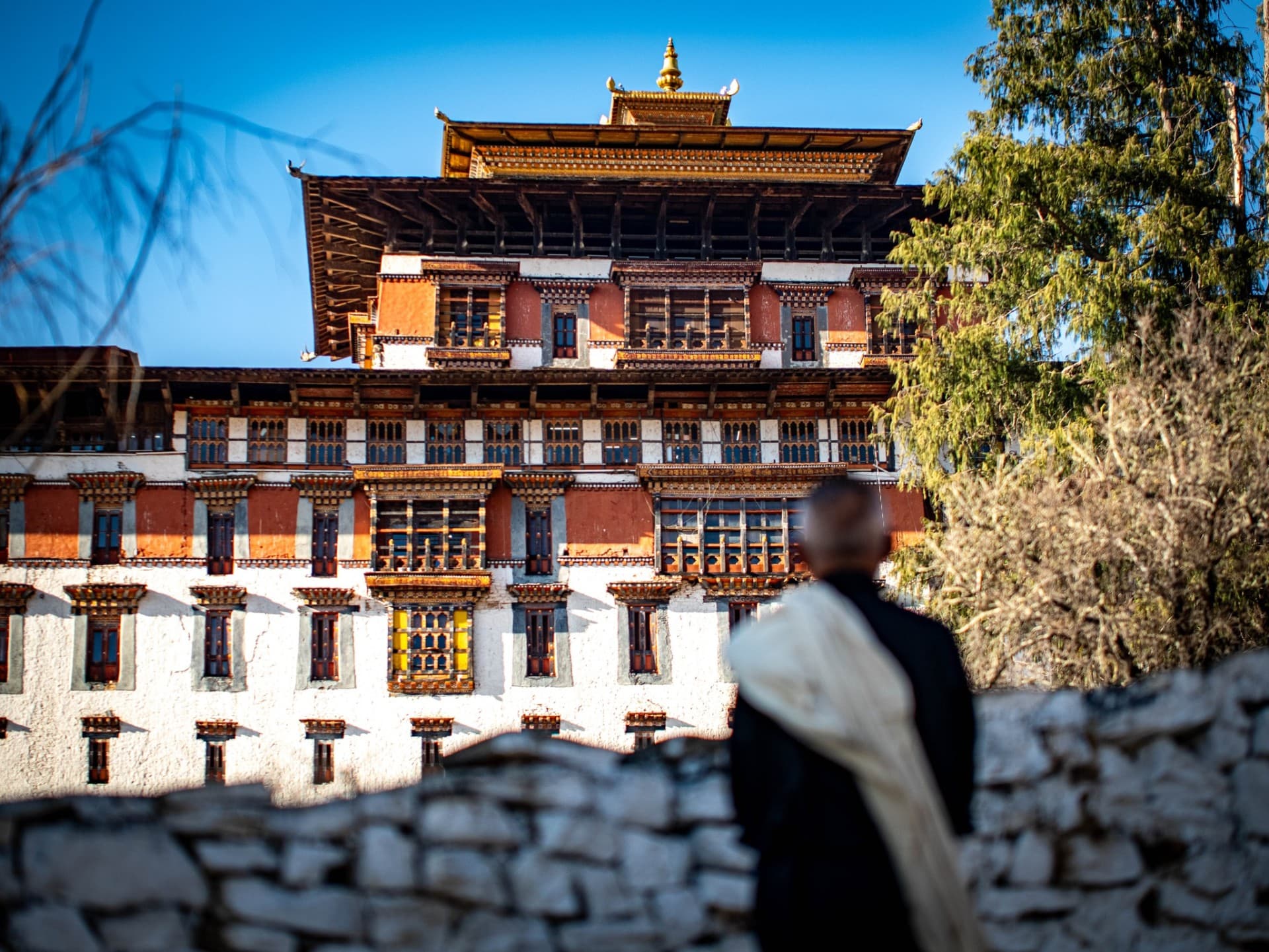
Bhutan receives fewer visitors in an entire year than Venice receives on a single afternoon. That comparison is not offered as trivia. It is the operating reality of a kingdom that has made a deliberate and sustained choice about what it will allow, and at what scale.
The traveller who arrives in Bhutan having chosen their operator carelessly will spend their days inside a system designed for volume, wearing the costume of exclusivity without any of its substance. The traveller who chooses a Bhutan tour operator with the right criteria in mind will move through the same country and have an entirely different encounter with it. The distinction begins long before the flight.
The first question is about a licence
Bhutan's Department of Tourism requires all inbound operators to hold an official licence. This is not a formality. The licensing structure exists because Bhutan takes seriously who it allows to bring people across its borders and how those people move through the kingdom once they arrive. An unlicensed operator, or one that sub-contracts through a chain of intermediaries, is working outside a system designed specifically to protect both the traveller and the country.
Ask directly: is this company a registered, licensed inbound operator with a physical presence in Bhutan? If the answer is a third-country agency booking through a Bhutan-based ground handler they have never met, you are already at a remove from anything genuine. The best Bhutan travel company is one with an actual address in Thimphu, real relationships with the monasteries and valleys their itineraries include, and a licence they can produce without hesitation.
The group tour wearing a private label
The vocabulary of luxury travel has been degraded by its own success. "Private" now appears on the websites of operators who run semi-private departures, group-adjacent itineraries capped at eight guests, or fixed-departure tours that simply mean you are not sharing a vehicle with strangers but are still following a pre-set route on a date the operator chose. A private Bhutan tour, properly understood, means a journey designed for you specifically, departing when you decide, moving at a pace you set, guided by someone whose sole professional responsibility on that trip is you.
The distinction matters more in Bhutan than almost anywhere else. The kingdom's monasteries are intimate. Its community encounters are genuine only when the numbers are small. A group of twelve at a village ceremony changes the nature of the ceremony. Two or four people with a skilled guide who has a personal relationship with that community changes it far less. Ask any operator you consider: how many other guests would share my guide, my vehicle, my itinerary? If the answer is more than your own travelling party, the word "private" in their materials is doing work it was never meant to do.
In Bhutan, the guide is not a supplement to the journey. The guide is the journey.
The guide is the journey
In most destinations, the guide is a useful supplement to the experience. In Bhutan, the guide is the experience. The kingdom does not reveal itself to the visitor who reads the plaque and moves on. It opens slowly, through conversation, through someone who can explain not just what the painting depicts but why it was commissioned in this particular dzong and what it meant to the monks who lived beneath it. A guide with a personal relationship with a head lama can arrange something that no amount of money alone can purchase. A guide who learned their itinerary from a company manual cannot.
Ask the operator about their guides directly. Not whether their guides are certified, because certification is a floor rather than a ceiling. Ask where they trained, how long they have worked in specific valleys, whether they speak the local dialect as well as English, whether they have a personal network beyond what the standard itinerary requires. The answers will tell you more about the quality of your journey than any photograph of a property.
Red flags that present as reassurance
The operators most likely to disappoint you are rarely the ones who seem obviously inadequate. They are the ones who use the right language while operating on the wrong principles. A heavily discounted rate on a private Bhutan tour is not a deal. It is a signal. Bhutan's Sustainable Development Fee exists, among other reasons, because the kingdom has decided that the visitor who pays properly is the visitor Bhutan wants. An operator willing to engineer a discount around that structure has already told you something about how they think of the country they are representing.
Generic itineraries should raise the same concern. If the proposed journey for a retired academic interested in Bhutanese textile traditions and the proposed journey for a couple on a milestone anniversary look substantially the same, the operator is not designing journeys. They are dispatching them. An itinerary for a discerning traveller should feel as though it could not have been written for anyone else.
What happens when the day changes
A journey through Bhutan is not a series of daytime excursions with a hotel at the end. The evenings matter. The unscheduled hour matters. The moment when the plan loosens and something unexpected becomes possible matters. Ask any operator you are considering: what happens when a traveller wants to slow down, to extend a day in a valley they had not expected to love, to visit somewhere that was not in the original plan?
The answer will tell you whether you are dealing with an operator who builds journeys with genuine flexibility, or one running a logistics company and calling it travel. Bhutan, more than most places, rewards the traveller who is willing to be altered by where they are. The operator's job is to create the conditions for that to happen, and then to stay out of the way.
The standard
Bhutan has maintained uninterrupted sovereignty for over fourteen centuries. It was never colonised, never asked to remake itself for an outside power, never required to perform its own culture as spectacle. The institutions that exist there today — the dzong system, the monastic tradition, the particular cadence of daily life — are the product of an unbroken civilisation.
The operator you choose to move through that civilisation should understand what they are holding. They should know the difference between showing you Bhutan and taking you into it. They should be capable of the restraint this kingdom has always required of those who enter it.
That is the standard. Apply it before you commit to anyone.
We keep our numbers small because Bhutan asked us to.
Ogyen & Co is a private luxury operator based in Thimphu, designing bespoke journeys through Bhutan for very few — by arrangement only, nothing discounted, nothing compromised.
Begin a correspondence