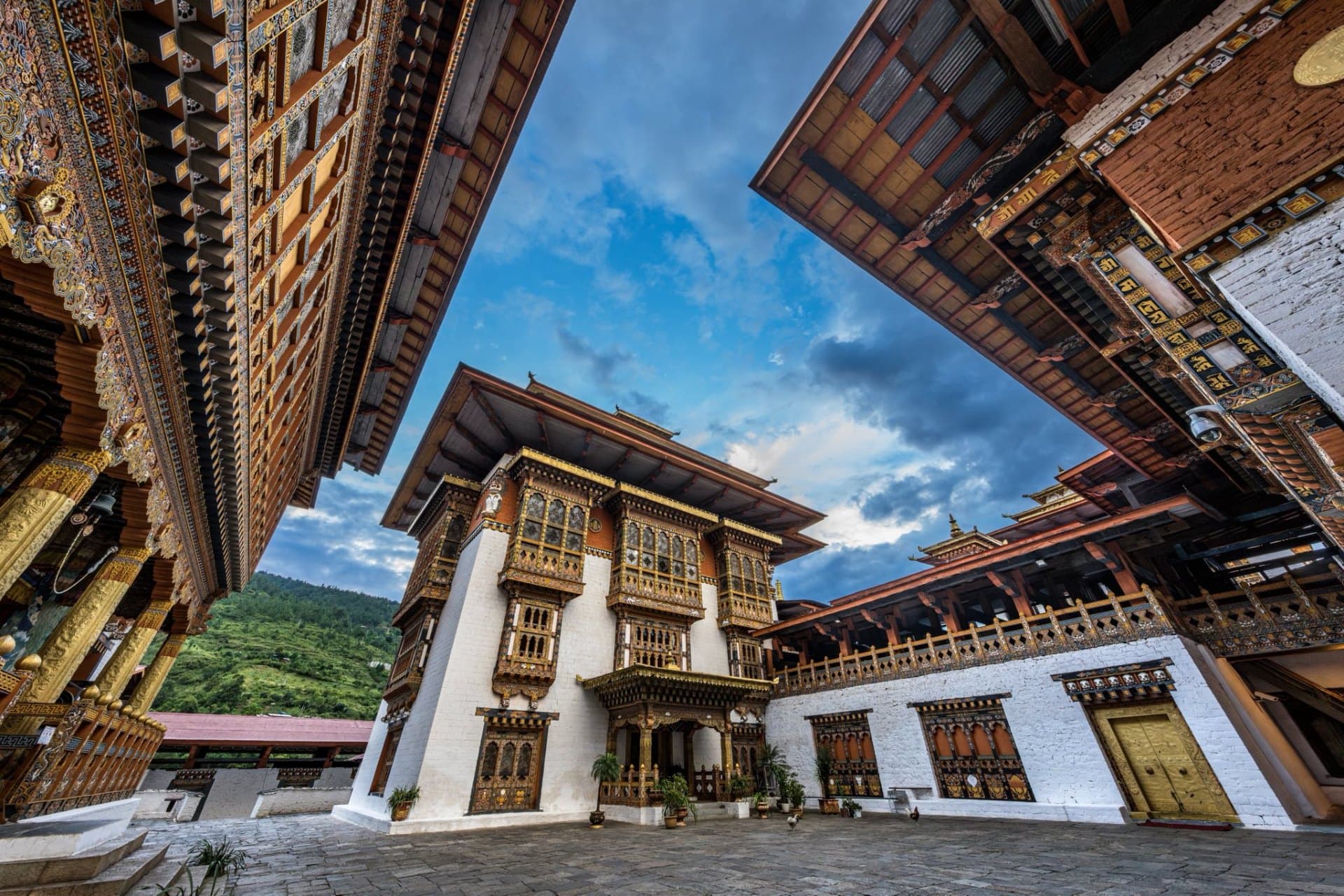
The question most travellers forget to ask, before they arrive, is which Bhutan they have come for. The country presents itself as a single destination, and in the sense that it holds one border and one cultural inheritance, it is. But the traveller who moves from the high, spare floor of Paro to the warm and fertile descent into Punakha, or who sits with the cranes in Gangtey on a January morning, begins to understand that Bhutan's valleys are not interchangeable.
They carry different climates, different architectural traditions, different relationships to the monastic calendar, and fundamentally different paces of life. No single itinerary can include all of them without trading depth for coverage, and depth is what Bhutan rewards. Understanding what each valley actually offers is not background reading. It is the design work itself.
Paro: austere, ancient, and impossible to avoid
Every journey through Bhutan begins in Paro, because Paro is where the only international airport sits, set into a valley so narrow that the pilots who land there require a special certification. The approach over the final ridge does not ease you in gently. It presents the country with full force: terraced fields, whitewashed farmhouses with elaborately painted facades, and the ruins of Drukgyel Dzong watching from a high ridge to the north.
Paro's character is spare and formal. Kyichu Lhakhang, one of the oldest temples in Bhutan, has been in continuous devotional use since the seventh century and carries the particular gravity of a place that has never been restored into tidiness. The Paro Dzong, standing above the valley on its own promontory, functions simultaneously as monastery and district administrative seat, which tells you something about how the sacred and the civic are arranged here. The Tiger's Nest monastery on its cliff face is the image most associated with Bhutan, and that association is deserved. But Paro is not a valley that reduces to its landmarks. It is a place of considerable antiquity, and those with the patience to move through it slowly will find it returning their attention.
Thimphu: the capital that chose its own terms
Thimphu is the only capital city in the world without a traffic light, a detail repeated often enough to risk losing its meaning, but one that still points at something genuine about the city's relationship to the pace of contemporary life. Bhutan's capital holds around 115,000 people, with government offices, the National Memorial Chorten, the weekly market, and Tashichho Dzong all within a compact and walkable valley. For the traveller who wants to understand the texture of modern Bhutanese life, Thimphu is not optional.
What Thimphu refuses to be is a capital trying to perform its own relevance. Strict building codes preserve traditional architectural features across commercial and residential buildings alike. The National Institute for Zorig Chusum, where students train in Bhutan's thirteen classical crafts, operates within walking distance of the government quarter, which is either a coincidence or a statement. The city has grown significantly in the last two decades and will continue to grow, but its relationship to scale remains deliberate.
Bhutan's valleys are not interchangeable. They carry different climates, different traditions, fundamentally different paces of life.
Punakha: the valley that gives most freely
Punakha sits at around 1,200 metres, the lowest and warmest of the principal valleys in western Bhutan, and the descent to it from the Dochu La pass is one of the more dramatic transitions the country offers. The air changes, the vegetation changes, and by the time the valley floor opens below, the traveller has left altitude behind and arrived somewhere genuinely warm. Punakha grows rice, citrus and banana. The afternoon light across the terraces and the farmhouses is the kind of light that photographs cannot adequately explain.
The dzong at the confluence of the Mo Chhu and Pho Chhu rivers is among the most architecturally serious buildings in the last Himalayan kingdom. It appears, from a distance, to sit on the water rather than beside it. The interior is cool and painted with a density of religious imagery that requires more than a single visit to absorb. Punakha is also the winter seat of the Central Monastic Body, which descends from Thimphu each October and returns in spring, so the dzong carries a different weight of human occupation at different times of year.
Gangtey: a valley that requires patience
The road to Gangtey crosses the Pele La at nearly 3,400 metres before the Phobjikha valley opens in a wide, treeless bowl below. The descent is gradual and the sense of arrival is distinct from anything in the western valleys: the space is wider, the pace slower, the silence more present. Gangtey Gonpa sits on a ridge above the valley floor and belongs to the Nyingma school, making it architecturally and institutionally unlike the dzong-anchored valleys to the west.
Gangtey is for the traveller who is capable of being still. The black-necked cranes that arrive from the Tibetan plateau each October and remain until February are the valley's most widely noted feature, but the valley does not need them to justify itself. The walking trails through the wetlands, the traditional farmhouses of the surrounding villages, and the quality of the winter morning light are individually sufficient. This is not a valley that gives itself up quickly. It is not designed to.
Bumthang: where the devotional life is oldest
Bumthang is the name given to a cluster of four valleys in central Bhutan, including Choskhor, Tang, Ura, and Chhume, each with its own personality but all sharing the quality of a landscape shaped by serious religious life since at least the seventh century. Guru Rinpoche, the Indian master credited with establishing Tantric Buddhism across the Himalayan region, is said to have spent significant time in Bumthang, and the feeling of that presence, whether or not one assigns it any literal weight, is perceptible in the density of sacred sites within a small geographic area. Jambay Lhakhang, Kurjey Lhakhang, and Tamshing Lhakhang are among the most spiritually significant temples in the kingdom, and none of them is decorative.
The traveller who arrives in Bumthang should arrive with time and without fixed expectations. The rhythm of religious activity across these valleys, the morning rituals, the festival calendar rooted in over fourteen centuries of unbroken practice, the relationships a good guide can facilitate with the community of practitioners living there, none of this is accessible to the itinerary that moves through in a single day.
The east: valleys that have not been simplified
Beyond the reach of most standard itineraries lie the valleys of eastern Bhutan, among them Lhuentse, Trashigang, and Trashiyangtse, requiring either a long mountain road or a domestic flight to reach. The east is culturally distinct from the west. It has its own weaving traditions, its own dialect, and a relationship to outside visitors that accurately reflects how rarely they appear. Some of these valleys receive a few dozen serious travellers in a year. The Merak-Sakteng plateau in the far east is home to the semi-nomadic Brokpa communities, whose way of life bears no resemblance to anything in the valleys most visitors see.
These are not valleys that accommodate themselves to a passing interest. They require careful preparation, genuine guide relationships that exist before the journey begins, and a readiness to travel in some physical discomfort in exchange for rewards that are qualitatively different from anything the western circuit provides. For the traveller who has already been to Bhutan and wants to understand what exists past the familiar route, the east is not an add-on. It is a different argument altogether.
We keep our numbers small because Bhutan asked us to.
Ogyen & Co is a private luxury operator based in Thimphu, designing bespoke journeys across Bhutan's valleys for very few — by arrangement only, nothing discounted, nothing compromised.
Begin a correspondence