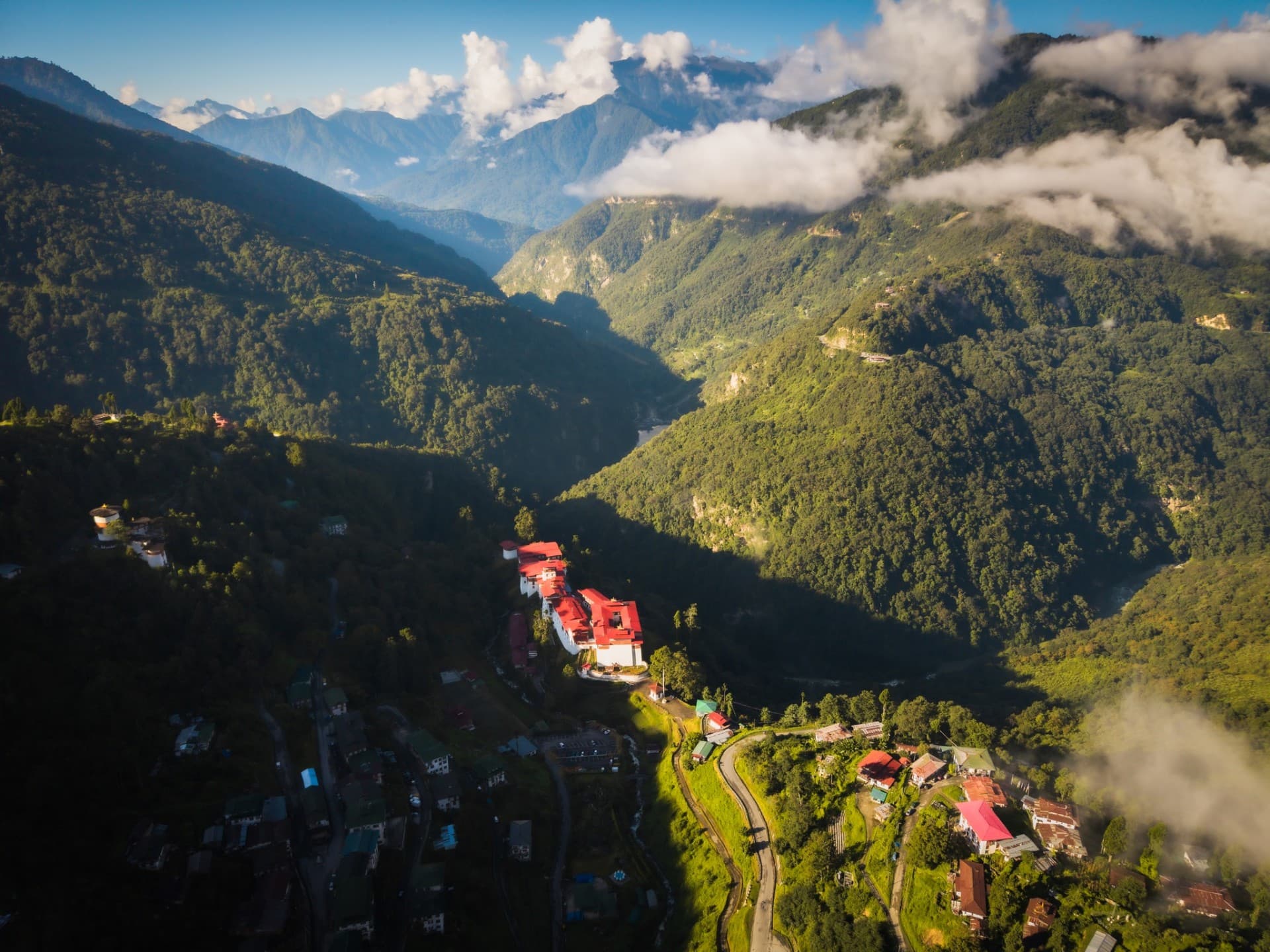
Most answers to the question of the best time to visit Bhutan arrive in approximately the same form: spring for the rhododendrons, autumn for the festivals, approach the monsoon with caution, consider winter only if you must. This is not wrong. It is simply not useful to the traveller who wants to understand what they are actually choosing between.
Bhutan is a country of extreme altitude variation, distinct seasonal character, and a religious and agricultural calendar that runs without pause all year. Bhutan also receives fewer visitors across an entire twelve months than Santorini receives across a single week in August. The restraint is structural. The question of when to arrive is not about avoiding crowds so much as understanding what each season is genuinely offering, and that depends entirely on what you have come for.
When the hillsides turn
Spring in Bhutan runs from early March through May, and for the traveller arriving in the middle weeks of that window, the kingdom offers something with no easy parallel: rhododendron forests in full bloom across elevations that range from subtropical valley floors to alpine ridges above four thousand metres. There are over forty-six species of rhododendron in Bhutan, and they do not all flower at once. The bloom moves upward with the warming temperature, so a journey planned across different valleys and altitudes in late March and April can follow the season as it climbs, encountering colour at one elevation in the morning and bare branches at another by afternoon.
The spring light in Bhutan has a particular quality. The haze that arrives later in the year has not yet gathered, and the Himalayan peaks are visible with a clarity that becomes rarer as the weeks advance. The temperature in the lower valleys is warm without being oppressive. Punakha, which sits at roughly twelve hundred metres, can feel almost subtropical in April while the passes above two thousand metres require serious layering at any hour. Bhutan in spring rewards the traveller who is prepared for a single day to contain several climates.
What the monsoon actually offers
The monsoon arrives in June and releases its grip in late August, and the consensus in most travel writing is to avoid it. This consensus deserves examination. The rainfall does make certain high-altitude routes impassable, and low cloud can settle over the views that define the experience in other seasons. These are genuine constraints, and no honest account of Bhutanese weather should minimise them. But the Bhutan of June and July is a country transformed in ways that the photographs of other seasons cannot prepare you for. The terraced rice fields fill with water and catch whatever light breaks through. The rivers run fast and the valleys are a depth of green that visitors who have only seen Bhutan in autumn or spring tend to find startling.
The traveller count during the monsoon is the lowest of the year. In a kingdom that already keeps its numbers deliberately small, this matters considerably. The monastery you reach in July may have no other visitors in the courtyard. The guide's attention is entirely yours for the duration. For those who have considered Bhutan seriously and want an encounter closer to genuine solitude, the monsoon is not a problem to be managed. It is an argument in the other direction.
The monastery you reach in July may have no other visitors in the courtyard.
Autumn and the weight of the festival calendar
September through November is Bhutan's most sought-after season, and for reasons that accumulate on one another. The monsoon has cleared, the air is sharp, and the light over the dzongs and valley floors in October carries a quality that visitors tend to describe with unusual consistency regardless of how much or how little they travel. The high-altitude trekking routes are at their most accessible. The temperature at lower elevations is generous, and cold enough at higher ones to make the evenings worth sitting through.
The autumn festival calendar adds a distinct dimension to the question of Bhutan's seasons at this time of year. The tsechu at Thimphu is one of the most significant gatherings in Bhutanese cultural life, and the festivals in Bumthang during October draw the monastic community and the local population together in a way that reveals something about the weave of daily devotion in the last Himalayan kingdom. The traveller who attends a tsechu with a private guide who has genuine relationships at the hosting monastery will have an encounter that a group arrival does not. The ceremony observed is the same. The access, and the understanding it produces, is not.
The case for winter
December through February is the season that most seasonal guides treat as a reluctant footnote, and it is the season that most rewards the traveller willing to read past the first recommendation. The reason is Phobjikha. Between October and February, several hundred black-necked cranes migrate from the Tibetan plateau to the wetlands of Phobjikha valley, and the sight of them moving through the pale winter light of the Gangtey bowl is among the genuinely distinctive experiences that Bhutan offers, with no equivalent anywhere else in the region.
Winter is also the season of architectural clarity. The valleys are dry, the air is cold and transparent, and the dzongs, which were built to be read against a landscape, present themselves with full force. Punakha becomes the winter seat of the monastic body that spends the warmer months in Thimphu, and the dzong at the confluence of the Mo Chhu and Pho Chhu rivers carries a different gravity during these months than it does when the tourist season is at its peak. The traveller who arrives in January is moving through a country that is not performing for them. That is a rare thing.
The question behind the question
Determining the best time to visit Bhutan is ultimately a question about what kind of encounter with the country you are seeking. The spring traveller following the rhododendron bloom and the winter traveller watching cranes land in Phobjikha are not visiting the same kingdom, though the kingdom they visit is the same. Neither is wrong. Both are having genuine encounters with a place that has refused to become ordinary, that has kept its own cultural and philosophical logic intact for over fourteen centuries without interruption or outside interference.
What a seasonal guide cannot provide is clarity about what you are actually seeking. A considered conversation with a good Bhutan operator, before any date is fixed, will produce a more useful answer than any list of months to prefer or avoid. The right time to arrive is the time that corresponds precisely to the journey you want to have. Arriving at that understanding is the work that comes first, and it is worth taking seriously.
We keep our numbers small because Bhutan asked us to.
Ogyen & Co is a private luxury operator based in Thimphu, designing bespoke journeys through Bhutan for very few — by arrangement only, nothing discounted, nothing compromised.
Begin a correspondence