The traveller who arrives in Bhutan having read a list of rules will be polite. The traveller who arrives having understood what those rules express will be something more than polite: they will be present, in a way that the country rewards with access that mere politeness does not unlock. Bhutan's customs and protocols are not arbitrary social conventions. They are the surface of a cosmology, a way of organising the world that has been developed over fourteen centuries of uninterrupted sovereignty, and understanding even a small part of that cosmology changes what a visit to a monastery or a dzong or a village farmhouse actually is.
This guide is not a checklist. It is an attempt to explain bhutan travel etiquette in terms of what it means, so that the visitor who follows it is not simply avoiding offence but actively deepening their own experience. That, in the end, is what good cultural understanding is for.
Entering Sacred Spaces
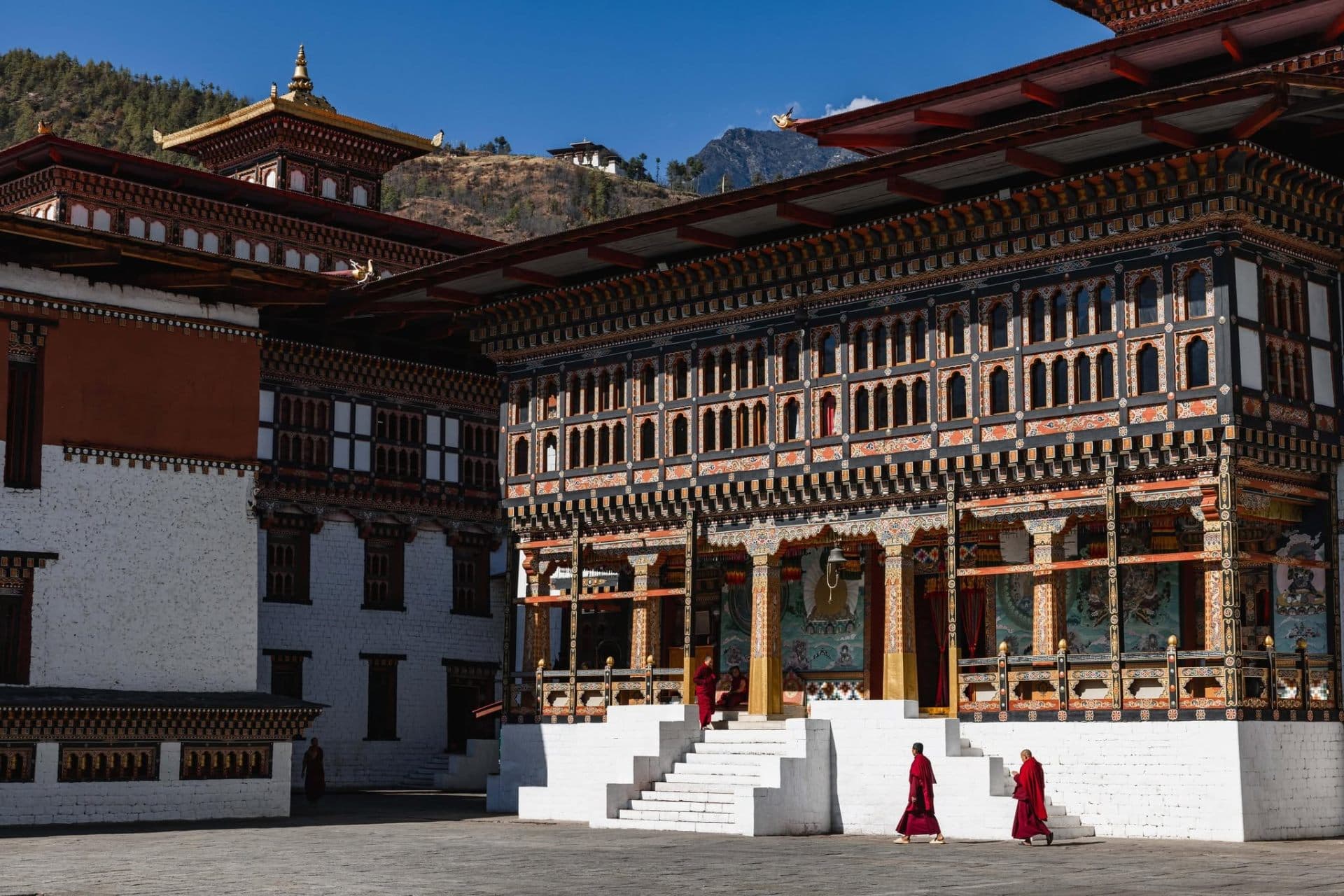
The dzongs and lhakhangs of Bhutan are not museums. They are active religious institutions, many of them continuously occupied for centuries, in which the daily rhythm of prayer, study, and monastic life proceeds with or without a visitor present. The protocols for entering them reflect that reality directly.
Shoes are removed at the entrance to most sacred spaces. This is not a hygiene measure. It is a gesture of humility, a physical acknowledgment that you are entering a space that operates on a different set of terms from the one you arrived from. The removal of shoes at a monastery threshold is the same gesture, in essence, as the lowering of the voice: it is the body acknowledging the nature of the place.
Photography inside temples and shrines requires specific permission and should be requested respectfully through your guide rather than assumed. Many inner sanctums do not permit it at all, and the correct response to that is gratitude for being permitted inside rather than disappointment at what cannot be documented. The experience of a butter-lamp room in Taktshang or the inner chapel of Jambay Lhakhang in Bumthang is not diminished by the absence of a photograph. It is, in many cases, deepened by it.
Dress modestly when visiting religious sites. For both men and women, covered shoulders and knees are the minimum. The Bhutanese standard is higher: in dzongs and at official locations, Bhutanese citizens are required by law to wear traditional dress, the gho for men and the kira for women. Visitors are not held to that standard, but arriving at a dzong in shorts is a statement about how seriously you are taking the encounter, and the monks and administrators who see you will read it accordingly.
They are the surface of a cosmology — a way of organising the world developed over fourteen centuries.
The Prayer Wheel and the Mani Wall
Along mountain paths, at valley crossings, at the entrances to villages, you will encounter mani walls: long low structures built from stones carved with the mantra Om Mani Padme Hum, and prayer wheels of varying sizes, from small handheld ones to large cylindrical drums set into walls that are turned by passing hands. These are not decorative. Each carved stone represents an act of devotion, and each turn of a prayer wheel is understood to release the mantra inscribed on the paper within.
The protocol is simple and worth knowing: pass mani walls and chortens on the left, keeping them to your right. Turn prayer wheels clockwise. These are not superstitions to be humoured. They are orientations that have structured Bhutanese movement through the landscape for centuries, and following them is a way of moving through the kingdom that is appropriate to its nature.
Interactions With Monks
Monks in Bhutan are not cultural guides or photographic subjects. They are people living a vocation that requires, among other things, discipline, study, and a degree of withdrawal from ordinary social life. The correct approach to a monk, if you wish to interact, is patience and respect rather than initiative. Allow the interaction to be offered rather than pursued. If a monk wishes to speak with you, they will. If they do not, the absence of interaction is not a rebuff. It is simply the shape of that particular moment.
Photographs of monks should never be taken without clear permission, given willingly and not under social pressure. A good private guide will navigate this naturally, because they have relationships within the monastic community that predate your arrival and will continue after your departure. Their judgment about when an interaction is welcome is worth trusting entirely.
Bhutan Customs in Everyday Life
Outside the formal religious context, bhutan customs culture in daily life is warm, unhurried, and hospitable in a way that repays attentiveness. If you are invited into a home, accept what is offered, including butter tea, which is an acquired taste that the gracious visitor does not decline on the first offering. The gesture of offering food or drink in a Bhutanese home is not casual. It is an expression of a hospitality tradition that predates modern tourism by many generations, and treating it as such is both correct and rewarding.
The pace of interaction in Bhutan is slower than most Western travellers are accustomed to, and this is not inefficiency. It is a different relationship with time, one that the bhutan dos and donts conversation rarely captures adequately. The visitor who adjusts their own pace, who does not hurry a conversation toward its conclusion, who sits with an experience rather than moving immediately to the next one, will find that Bhutan opens in proportion to that willingness.
Understanding is not a courtesy. It is the form access takes here.
Understanding as Access
The traveller who understands Bhutanese cultural protocols is not merely a more considerate visitor. They are a more complete one. The monastery that reveals its inner chapel to the guest who has arrived correctly, the monk who pauses to speak with the visitor whose guide vouches for their genuine curiosity, the farmhouse family who relaxes into a real conversation rather than a performed welcome: these are the experiences that separate a journey through Bhutan from a tour of it.
Arriving With Care
Ogyen & Co is a private luxury operator based in Thimphu, fully licensed with Bhutan's Department of Tourism. Our guides are chosen not only for their knowledge of Bhutan's history and landscape but for the depth of their cultural relationships within the kingdom. If you are considering Bhutan and would like to discuss a journey shaped by genuine engagement rather than surface observation, we welcome correspondence by arrangement only.
We try to design journeys that honour that distinction. We keep our numbers small because Bhutan asked us to.
Begin a correspondence