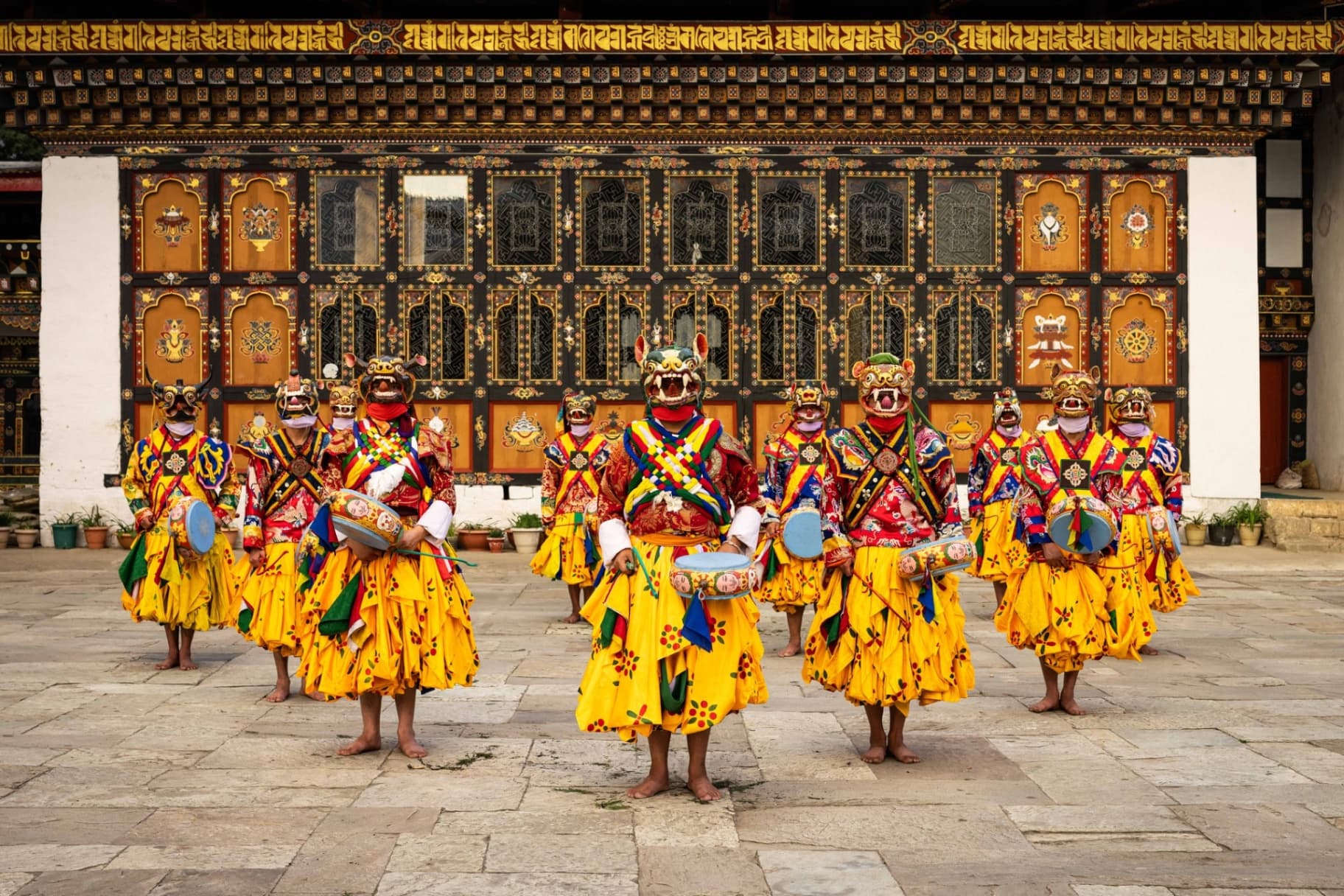
The tsechu is not a performance. This is the first thing to understand and, for the visitor arriving from outside, the hardest to hold onto. The masked dances, the ceremonial music, the hours of ritual that fill the courtyards of Bhutan's dzongs and monasteries across the festival calendar are not staged for the visitor's benefit. They are acts of devotion: the observance of a tradition that connects the present community to the teachings of Guru Rinpoche, the eighth-century master who brought Tantric Buddhism to the Himalayan region and whose presence in Bhutan is felt as something ongoing rather than historical. The bhutan tsechu festival is also, increasingly, the subject of tour packages that miss entirely what makes it significant. What the traveller witnesses at a tsechu depends less on which festival they attend than on how they arrive at it. Bhutan receives fewer visitors across an entire year than Florence receives across a long weekend, and the tsechu is one of the events that explains why that restraint has been worth protecting.
What the Tsechu Actually Is
The word tsechu means tenth day in Dzongkha, referring to the tenth day of the lunar month, which is considered auspicious in the Vajrayana Buddhist tradition as the day associated with Guru Rinpoche's birth. Tsechus are held in dzongs and monasteries across Bhutan according to a calendar that varies by valley and institution, with significant gatherings occurring in Paro, Thimphu, Punakha, and Bumthang across the year. The festivals typically run for three to five days and involve Cham dances performed by monks who have trained for the specific purpose over years of dedicated practice.
The Cham dances are not decorative. Each enacts a specific teaching: the subjugation of demonic forces, the celebration of liberation, the depiction of karmic consequence. The costumes, masks, and movements have been transmitted without interruption for centuries, and the monk performing the dance is understood not merely to represent a deity but to temporarily embody one. Attending a tsechu with a guide who can explain what is being enacted, and why it matters to the community watching it, is a qualitatively different experience from watching the same event without that understanding. The visual spectacle is available to everyone present. The meaning is not.
What the group version offers
There is a version of the bhutan tsechu festival experience that has become increasingly common and increasingly limited. It arrives by coach, occupies a designated viewing area, follows a schedule that allocates a fixed number of hours to the ceremony, and departs before the afternoon dances begin because there is a restaurant booking at the end of the day. This version produces photographs. It produces very little else.
The issue is not the number of people present. A tsechu is a community gathering and has always involved large numbers of Bhutanese devotees from the surrounding valleys. The issue is the mode of arrival and the quality of presence it generates. The visitor who arrives as part of a group, without a guide whose specific knowledge of this monastery and this festival extends beyond the printed itinerary, is watching something they cannot fully access. The ceremony is not withholding itself. The visitor simply lacks the frame required to receive it, and a fixed-departure package has no structural interest in providing that frame.
The monastery is not performing for them. It is observing its own devotional calendar, and the guest has been received into that observance rather than positioned in front of it.
What a private arrival changes
The traveller who attends a tsechu with a guide who has a genuine relationship with the head monk of the hosting monastery occupies a different position within the same event. Not necessarily a different physical position, though that may be arranged. Something more significant: the context to understand what they are watching, an introduction to a local family who has attended this festival for three generations, the knowledge of when to be present and when to withdraw respectfully, the capacity to ask questions that receive real answers rather than gestures toward the obvious.
The private traveller at a bhutan tsechu is not watching a performance from outside. They are, to the degree that any visitor can be, inside the event as it actually operates. This is the distinction between attending a tsechu and witnessing one. It is a distinction that no fixed itinerary and no group departure can manufacture, because it is not a product of proximity. It is a product of relationship, and relationship takes time.
The calendar beyond Paro
The Paro tsechu, held in spring, is the most widely known, partly because it coincides with the most popular travel season and partly because Paro is where most international journeys to Bhutan begin. It deserves its reputation. The dawn unfurling of the Thongdrel, a vast silk thangka displayed once a year in the early morning light for blessings before the sun reaches it, is among the genuinely distinctive events on the Bhutanese calendar.
But the bhutan festivals calendar extends well beyond Paro. The Punakha tsechu, held in late February or early March, coincides with the end of the monastic winter season and takes place at one of the most architecturally significant dzongs in the last Himalayan kingdom. The Bumthang festivals, including the Jambay Lhakhang Drup in autumn, unfold in the spiritual heartland of Bhutan and draw a more local attendance than the internationally known gatherings, which changes their character substantially. The traveller who has understood what a tsechu actually is will identify the right festival to attend rather than defaulting to the most photographed one.
The guide the festival requires
There is a version of the festival guide who stands beside the visitor and translates what they can see. There is another version: the guide who has attended this particular tsechu for fifteen years, who knows which monk learned the Cham dances under which teacher, who can arrange for the travelling party to meet a local family before the ceremony begins so that the context is already present when the first drum sounds.
The access that matters at a bhutan tsechu festival is not physical proximity to the dances. It is the depth of understanding available to the person watching. A visitor who knows what the Black Hat dancer is enacting, who sat that morning with a family for whom this ceremony is among the most important days of the year, who has a guide capable of translating not just language but significance, is attending a different event than the one visible from the official viewing area. That guide exists. Bhutan has refused to become ordinary in large part because its culture is held by people whose knowledge of it is living rather than professional, and the private traveller who arrives through the right operator finds that knowledge made available to them in a way that group travel structurally cannot offer.
We keep our numbers small because Bhutan asked us to.
Ogyen & Co is a private luxury operator based in Thimphu, designing bespoke journeys through Bhutan for very few — by arrangement only, nothing discounted, nothing compromised.
Begin a correspondence