There is a standard Bhutan itinerary, and it is not a bad one. It lands in Paro, drives to Thimphu, crosses Dochu La to Punakha, returns to Paro, climbs to Taktsang and flies out. Some versions add Phobjikha. Fewer add Bumthang. Almost all of them fit into eight or nine nights, and almost all of them try to see everything the western valleys hold.
We build from the same valleys. What differs is not the map. It is the order, the pace, and above all the list of things deliberately not done.
A Bhutan luxury itinerary is not measured by how much it contains. Every operator in the kingdom can arrange access to the same dzongs and the same trails. What they cannot all arrange is the space between them, which is where the journey actually takes place.
Why Thimphu Comes First
The flight lands in Paro, and the instinct is to stay there. Paro holds the national museum, Rinpung Dzong, Kyichu Lhakhang and the trailhead to Taktsang, and it seems efficient to begin where one arrives.
We do not. Our journeys drive straight from the airport to Thimphu, roughly an hour and a half, and return to Paro at the end. The reasoning is physiological before it is aesthetic. Taktsang sits at around 3,100 metres, with a climb of roughly 700 to 900 metres depending on where it is counted from, and a body that has spent a week between 1,200 and 3,000 metres climbs it very differently from one that landed two days earlier.
There is a narrative reason too. Thimphu is the kingdom explained: the capital, the institutions, the Royal Textile Academy and the school of the thirteen traditional arts, the weekend market where the valley sells what it grows. A traveller who meets Thimphu first understands what they are looking at for the rest of the journey. A traveller who meets it last is merely checking it off.
The Valleys, in Order
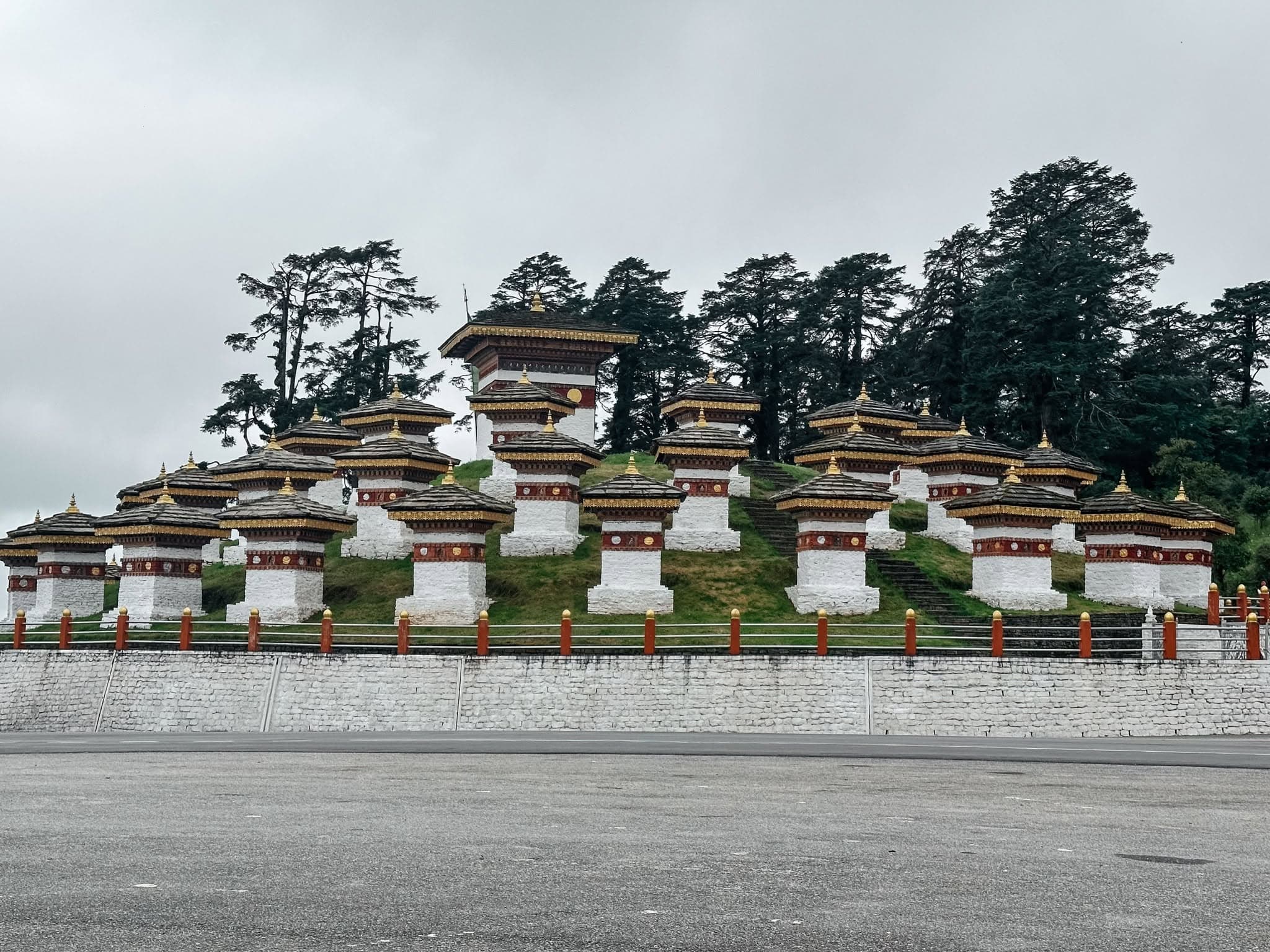
From Thimphu the road climbs to Dochu La at around 3,100 metres, where 108 memorial chortens stand against the range on a clear day, and then descends into Punakha at about 1,200 metres. The drive is around three hours as most operators run it, and longer as we do, because the pass deserves a pause and the valley floor deserves an unhurried arrival.
Punakha is where the kingdom softens. The dzong sits at the confluence of two rivers, the rice is terraced to the water, and the air is warm enough in most months to eat outdoors. Two nights here is the minimum. The walk to Khamsum Yuelley Namgyal Chorten, the long suspension bridge over the Pho Chhu, and Chimi Lhakhang in its fields each ask for a morning, not an hour.
From Punakha the road climbs again, roughly three hours, to Phobjikha, the glacial valley below Gangtey Goenpa. This is the stage most short itineraries remove, and the one we most often insist on keeping. It is quiet in a way the western valleys are not, and in the crane season from late autumn into winter it is one of the most particular places in the Himalaya.
For journeys of ten nights or more, the route continues east through Trongsa to Bumthang, the spiritual heartland, where the oldest temples in the kingdom sit within an afternoon of each other. The drive from Gangtey is four to five hours the way we take it, with stops. On long sectors we do not use roadside restaurants. We set a private picnic, with food prepared by a five-star hotel, somewhere the guest would choose to stop anyway.
The Return West
Bumthang presents the one routing problem that matters. The road back to Paro is long enough that it undoes much of what the journey has built, and we do not schedule it. The return is by the domestic flight to Paro, or, where the guest prefers, by helicopter, which removes most of the weather risk and keeps the range in view for the whole crossing. Helicopter sectors are quoted separately.
Paro then closes the journey. The body is acclimatised, the eye has learned what a lhakhang is for, and Taktsang can be approached as what it is rather than as a physical test. We begin the ascent early, often before six in the morning, to reach the monastery ahead of the day's traffic.
What We Take Out
Here is the part that is harder to sell.
We remove the second dzong in a day. We remove the museum a guest has no particular interest in. We remove the scheduled shopping stop, the obligatory archery demonstration, the farmhouse visit that has been performed so often it has become a set. We remove the attempt to see Paro, Thimphu, Punakha, Phobjikha and Bumthang in seven nights, which can be done and should not be.
The principle is simple to state: one significant encounter each morning, one each afternoon at most, and at least one day in every four with nothing on it. That last day is where guests most often tell us something happened, usually in a courtyard or on a walk no itinerary would have listed.
Nine Days, Drawn Plainly
For a first journey of nine days and eight nights, the shape we return to most often is two nights in Thimphu, two in Punakha, two in Phobjikha and two in Paro. It holds the capital, the warm valley, the quiet one and the sacred cliff, in that order, and it leaves space in each.
For twelve days or more, Bumthang earns its place, with the flight or helicopter back to Paro. For six or seven days, we would rather lose Phobjikha than compress it, and we would say so before the guest has to ask.
None of this is a template. It is a sequence of reasons, and the reasons change with the season, the guest's interests and the lodges available on the dates. But the reasons hold, and a route built on them tends to feel, by the last morning, like one continuous thing rather than nine separate days.
Ogyen & Co designs bespoke private journeys through Bhutan for very few guests each year. Every route begins with what the guest would regret missing and ends with what they would never notice was removed. Drive times are approximate and depend on road conditions and the pace each journey is given. We welcome correspondence by arrangement only.
We try to design journeys that honour that distinction. We keep our numbers small because Bhutan asked us to.
About Ogyen & Co
Ogyen & Co is a licensed private tour operator based in Thimphu, designing bespoke journeys through the Himalayan Kingdom of Bhutan for a small number of guests each year. Single departures only, by arrangement.
ogyen.co · Private journeys · Travelogues · Enquire · hello@ogyen.co