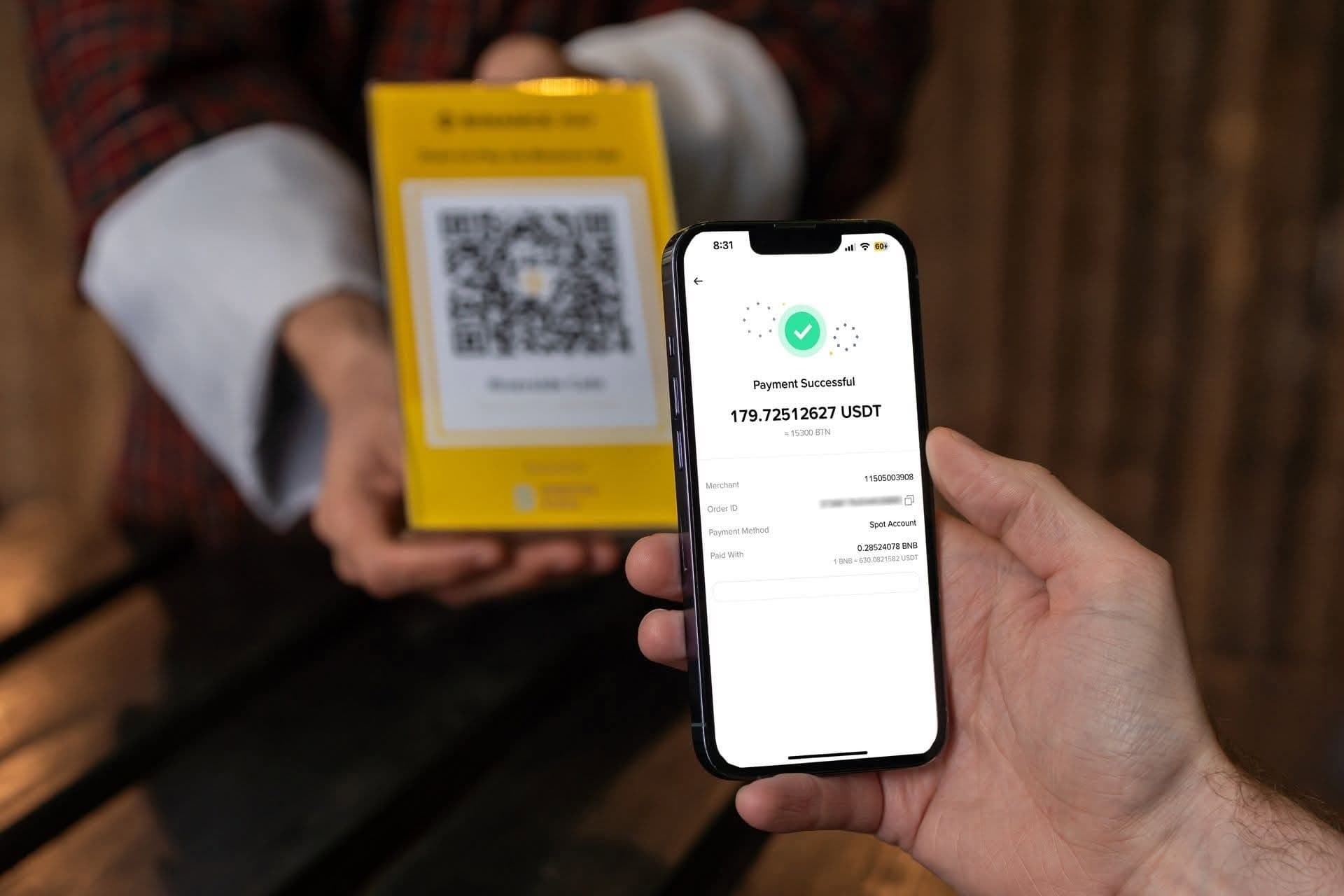
In May 2025 Bhutan became the first country to run a national crypto payment system for tourism. The Department of Tourism built it with Binance Pay and DK Bank, the kingdom's fully digital bank, and at launch more than a hundred merchants were live, from hotels to fruit sellers on the road between valleys.
The announcement travelled further than most news from Thimphu does, and it travelled with errors attached. We have read that tourists can pay the Sustainable Development Fee from any wallet they like, that a fixed share of operators now accept Bitcoin directly, and that fuel pumps take Ether. None of that is how the system works. This chapter sets out how it does.
How the System Works
The national system runs on Binance Pay. A guest with a Binance account scans a QR code, static at a market stall or dynamic for a larger invoice, and pays in any of the supported assets. At launch that meant more than a hundred cryptocurrencies, Bitcoin, BNB and USDC among them. The merchant is settled through DK Bank.
What it covers is broad. The scheme was designed to reach flights into Paro, the tourist visa and the Sustainable Development Fee, hotels, guides, monument entry and local shopping. In practice, a guest can settle nearly every part of a Bhutan journey without a card.
What it does not cover matters as much. Payment runs through Binance Pay, so a guest needs a Binance account. A self-custody wallet on its own is not enough, and an exchange account elsewhere does not connect. A guest who holds their assets in cold storage will need to move what they intend to spend before they travel.
How We Accept It
Ogyen & Co accepts crypto through Binance Pay via DK Bank, the same rails the national system runs on. A journey is quoted in US dollars, as every journey in the kingdom is. When the guest chooses to pay in crypto, we issue a Binance Pay request for that amount, and the app shows the equivalent in the asset the guest chooses at the moment of payment.
The quote does not move with the market. The guest carries the price risk until the moment they pay, and not after. Deposits and balances follow the same schedule as any other journey, and the terms of each are set out in writing before anything is paid.
There is one convenience worth naming. A guest who pays the whole journey this way pays the land arrangements, the lodges we contract and the government levies we handle on their behalf in one currency, through one app, with a confirmation on their phone a few seconds later. For someone who already keeps most of their wealth on-chain, that removes a conversion they would otherwise make twice.
What It Does Not Change
Paying in Bitcoin does not change the price of a journey in Bhutan, and it should not. The Sustainable Development Fee is the same in any currency. Lodge rates are the same. We do not offer a discount for crypto, because a discount would imply the asset is worth less to us than the dollar it represents, and we do not think that.
Nor does it change what the journey asks of the guest. The national payment system makes the kingdom easier to pay for. It does not make it easier to understand, and a traveller who arrives expecting a frictionless country because the payments are frictionless will find the dzongs, the dress codes and the drive times exactly as they were.
Why Bhutan Did This
It would be easy to read the scheme as a marketing gesture, and there is some of that in it. But the more interesting reason is structural. Bhutan has been mining Bitcoin with its own hydropower for years, through the state's investment arm, and holds the proceeds as a national asset. A country that keeps part of its reserves in Bitcoin has a reason to let visitors spend it, and the tourism scheme is one place where that position meets the public.
The other reason is the one the Department of Tourism gave at launch: small vendors in remote valleys, who could never take a foreign card, can now take payment from a foreign guest with nothing more than a printed code. That is not a small change in a country where much of the craft economy sits several hours from the nearest bank branch.
Before You Pay
For a guest planning to pay in crypto, the preparation is short. Open or verify a Binance account well before travel, since verification can take time. Move the amount you intend to spend into it before departure rather than from the road, where mobile coverage in the high valleys is uneven. Keep a card as a fallback, because not every merchant in the kingdom is on the scheme.
Ogyen & Co designs bespoke private journeys through Bhutan for very few guests each year, and accepts payment in crypto through Binance Pay via DK Bank for any journey we arrange. Payment systems, supported assets and government levies change and are confirmed in writing for each journey. We welcome correspondence by arrangement only.
We try to design journeys that honour that distinction. We keep our numbers small because Bhutan asked us to.
About Ogyen & Co
Ogyen & Co is a licensed private tour operator based in Thimphu, designing bespoke journeys through the Himalayan Kingdom of Bhutan for a small number of guests each year. Single departures only, by arrangement.
ogyen.co · Private journeys · Travelogues · Enquire · hello@ogyen.co