Paro Taktsang is extraordinary. There is no honest account of Bhutan that diminishes it, because the monastery on its cliff face above the Paro valley is precisely what it appears to be: an ancient place of genuine devotion, improbably built, continuously inhabited, and in possession of a quality that its growing number of visitors has not yet managed to remove. Tiger's Nest deserves its reputation. It has also, in recent years, begun to show the particular pressure that fame exerts on the places it selects. The path up the cliff is well-worn. The queues at certain hours are real. The experience of arriving there in a crowd is a different experience from the one the place is capable of providing. This is not a complaint about Tiger's Nest. It is an observation about what happens when a single image comes to represent an entire kingdom, and about the off the beaten path Bhutan that continues to exist, in full force, behind that image.
What fame does to a place
The process by which a destination becomes its own most famous photograph is familiar enough that it needs no extended analysis. The image circulates, the visitor arrives to verify it, the arriving visitor becomes the crowd that the next visitor is trying to avoid, and the place itself — the actual stone and butter lamp and morning silence — recedes behind the accumulated weight of its own representation. Bhutan's most iconic sites have not yet reached the saturation of Venice's Rialto Bridge on a summer afternoon, where the footfall has become its own phenomenon. But the trajectory, on the cliff path above Paro, is visible, and the traveller who arrives expecting solitude on a clear October morning may find something different.
What matters for the serious traveller is understanding that this process has touched a very small portion of the country. The famous cliff, the Punakha Dzong at river's confluence, the Thimphu weekend market: these are the places that have entered the circulation of images and acquired the visitors that images attract. The rest of the kingdom, which is to say the overwhelming majority of it, has not. The monastery in an eastern district that receives perhaps forty serious visitors a year is not inaccessible. It simply does not appear in the itinerary that begins with a search engine.
The valley that requires a relationship
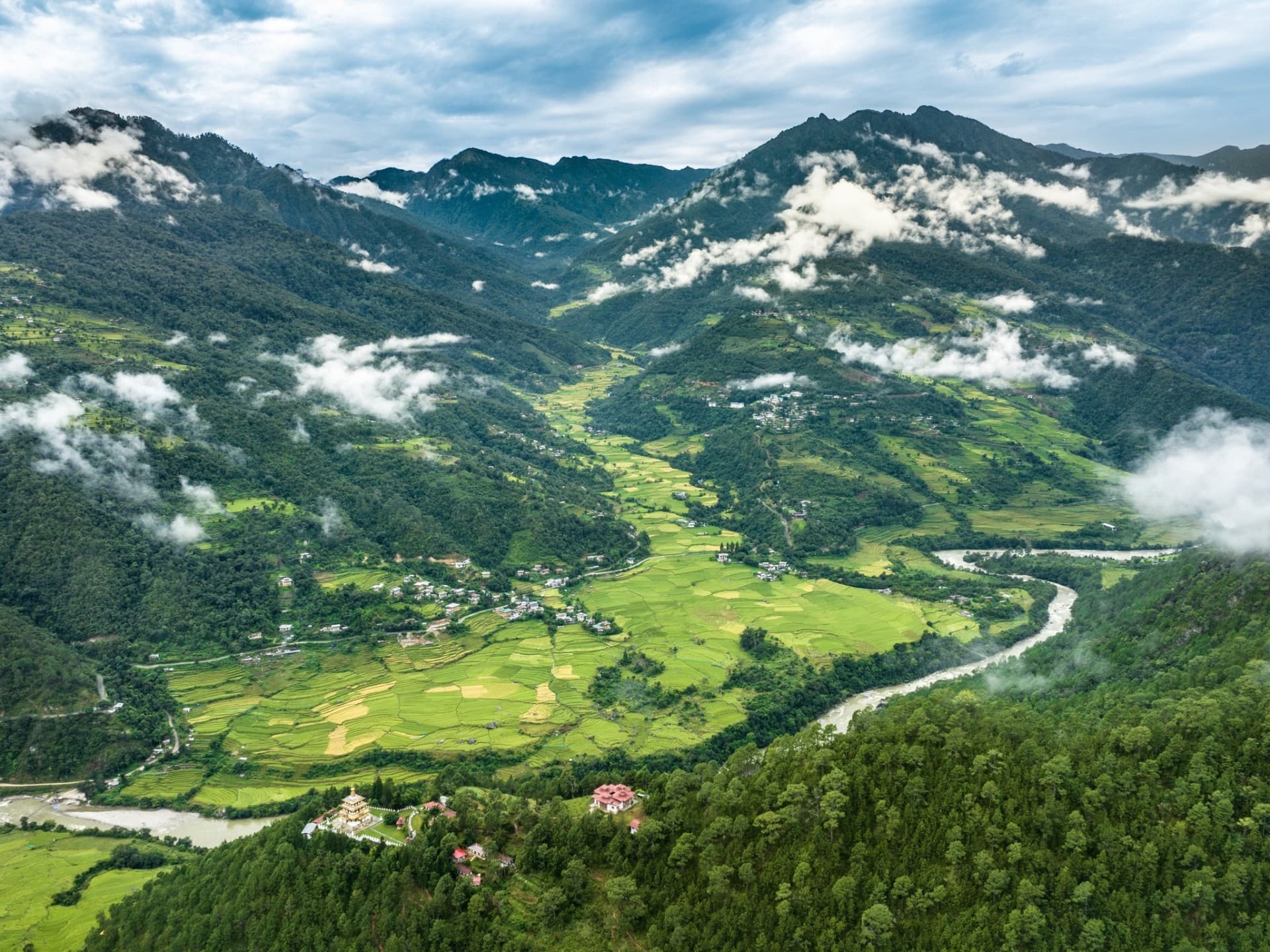
There is a valley in Bhutan, reachable by a road that most operators have no reason to use, where the monastery at the far end has a presiding lama who has received, over the course of his tenure, a number of outside visitors that could be counted in the hundreds rather than the thousands. The monks there are accustomed to the rhythm of their own community rather than to the presence of cameras. The courtyard in the morning holds the particular quality of a place that has not been adjusted for observation.
Access to this valley is not a matter of money or the right tour package. It is a matter of the guide's relationship with the people inside it. The guide who has visited over many years, who knows the correct form of greeting and the hours when a visitor's presence is welcome and those when it is not, can bring a small travelling party into an encounter that the standard circuit has no mechanism to provide. The off the beaten path Bhutan that matters most is not geographic remoteness. It is relational depth, and that depth is either present in your guide's biography or it is not.
The off the beaten path Bhutan that matters most is not geographic remoteness. It is relational depth.
The festival that has no tour group presence
Bhutan's festival calendar extends well beyond the tsechus that appear in tour operator brochures. In the smaller valleys, in the monasteries that serve local communities rather than visitor itineraries, festivals take place across the year according to a religious calendar that has been in continuous operation for centuries. These are events attended by the community they belong to. The monks who perform the masked dances are performing them for local devotees, for the deity being honoured, for the continuation of a tradition that predates tourism by a considerable margin.
The traveller who arrives at one of these festivals as part of a large group changes the character of the event. The traveller who arrives in a small party, introduced through a guide whose relationship with the monastery is long-established, is inside something different. Not a managed cultural experience but the thing itself: a community observing its own devotional life, into which the visitor has been received rather than accommodated. These Bhutan hidden places and private ceremonies are not listed on booking platforms. They are accessible only to the operator with genuine roots in the kingdom, whose guides have been present for long enough that their presence requires no introduction.
What the east holds
The eastern districts of Bhutan represent the most concentrated set of exclusive Bhutan experiences that most itineraries never approach. The roads are longer, the domestic flights infrequent, the infrastructure deliberately limited in ways that reflect the kingdom's preference for keeping certain parts of itself available only to those who make a genuine effort. The weaving traditions of the east are distinct from those of the western valleys. The dialect changes. The relationship between the local community and the monastic institution carries a different historical weight than in the more visited parts of the country.
The traveller who has been to Bhutan before and wants to understand what lies past the familiar journey will find the east offers an answer unlike anything in the western circuit. This is not deprivation tourism. The east offers its own forms of physical comfort and genuine hospitality. What it does not offer is the reassurance of the already-seen. The traveller who arrives there is, in the most clarifying sense, somewhere they have not been before, in a country that has refused to become ordinary across fourteen centuries of uninterrupted sovereignty.
The guide who makes it possible
The Bhutan that exists behind the famous photograph is not hidden in any dramatic sense. It is simply not reachable through the standard mechanisms of travel booking. No algorithm returns the monastery with forty visitors. No platform lists the festival in the small valley. No operator running group departures on fixed itineraries has any structural reason to invest in the relationships that would make these places accessible.
The guide whose knowledge of Bhutan extends into this territory is not a specialist add-on to an otherwise standard journey. They are the entire proposition. What they carry — the personal networks, the years of sustained presence in the kingdom, the understanding of when to ask and when to wait — is the product of a commitment that takes time and cannot be manufactured quickly for the benefit of a brochure. For the traveller who wants this Bhutan, by arrangement only and for very few, the guide is where the itinerary begins.
We keep our numbers small because Bhutan asked us to.
Ogyen & Co is a private luxury operator based in Thimphu, designing bespoke journeys through Bhutan for very few — by arrangement only, nothing discounted, nothing compromised.
Begin a correspondence