Almost every conversation about the cost of visiting Bhutan begins with the same number, and almost every conversation gets it wrong in the same way.
One hundred dollars per person per night, paid to the government, for the privilege of being in the country. Travellers hear it and conclude either that Bhutan is prohibitively expensive or that it is charging admission to itself. Both readings treat the fee as a barrier, which is understandable, and neither describes what the instrument actually does or why it is the most interesting piece of policy in Himalayan travel.
The Sustainable Development Fee is not a price on access. It is a price on time. That distinction is the whole subject of this essay.
What the Fee Is, and What It Replaced
The mechanics first, because they are widely misreported.
The SDF is one hundred US dollars per person per night for most international visitors, fixed at that rate until 31 August 2027. Indian nationals pay a reduced rate in rupees, children between six and twelve pay half, and children of five and under are exempt entirely. The visa is a separate one-off charge of forty dollars rather than a nightly one, and since January 2026 a five percent goods and services tax applies to in-country tour services, though not to the SDF itself and not to the airline.
Critically, the fee covers none of your accommodation, meals, guide or transport. It sits alongside them. This surprises people who assume that a hundred dollars a night must be buying something, and it is the source of most of the confusion in the market.
The more revealing part is the history. Until June 2022, Bhutan ran a Minimum Daily Package Rate: a government-set floor that bundled hotel, food, guide and transport together, with a sixty-five dollar royalty buried inside it. That system was abolished, the royalty was replaced by a two hundred dollar Sustainable Development Fee, and in 2023 the fee was halved to its present level.
What happened in that reform is more consequential than the number. For roughly five decades the state had been setting the shape of the product. Every visitor bought a package the government had defined, and differentiation happened as a surcharge on top of a fixed template. The 2022 decoupling ended that. The fee became a clean per-night levy, and what a journey through Bhutan costs became a question for the market rather than the ministry.
Bhutan's genuine luxury market is, in its current form, about four years old. That is why so much has arrived at once, and why the country's positioning is still being worked out in public.
The Fee Is Regressive, and That Is the Design
Here is the arithmetic that nobody in the industry states plainly, and it is the single most useful thing a prospective guest can understand about the bhutan luxury travel cost.
A night in Bhutan, excluding the fee, currently runs anywhere from around two hundred and fifty dollars to two thousand dollars per person depending on what you have chosen. The SDF is a flat hundred dollars regardless.
At the bottom of that range, the fee is close to a third of the total and it is decisive. It is the difference between the trip happening and not happening. At the top of the range, it is roughly five percent, which is less than the tax on the tour services and considerably less than the variance between two adjacent room categories at the same property. For a guest travelling at that level it is, in strict financial terms, a rounding error.
A flat per-night levy in a market with an eightfold price spread is regressive by construction. Its effect falls almost entirely on the price-sensitive end and barely touches the top. Whether or not that was the explicit intention in 2022, it is unambiguously the function, and it is the mechanism by which a country of Bhutan's size keeps its visitor numbers where they are.
This produces an uncomfortable but honest conclusion. If you are considering a serious private journey through this country, the SDF is not your constraint and worrying about it is a misallocation of attention. The fee will not determine your budget. It determines who else is standing at Taktsang on the morning you climb it, and that is what you are actually buying.
There is a second-order effect worth noting, because it runs against intuition. Since the fee accrues per night, a longer stay costs more in absolute terms, which appears to argue for compressing the itinerary. In practice it argues for the opposite. The fixed costs of reaching Bhutan are substantial and indifferent to duration: the flights, the difficulty of the connection, the days given up in transit. Spread across four nights, those costs dominate. Spread across ten, the marginal night is by some distance the cheapest thing on the invoice, and it is also the night on which the country finally stops being a series of arrivals. The old incentive schemes that gave free nights for longer stays were discontinued at the end of 2023, so the argument now has to stand on its own merits. It does.
What You Can Verify and What You Cannot
Every operator in Bhutan will tell you that your fee funds free healthcare, free education, forest conservation and cultural preservation. That is the government's stated allocation and it is repeated everywhere.
We would rather be straightforward about the epistemics. Money paid into a national exchequer is fungible, no visitor receives an accounting of their particular hundred dollars, and any operator who assures you that your specific fee planted a specific tree is telling you a story. You should be mildly suspicious of that story, as you would be of any brand that offers you a clean causal line between your spending and a virtue.
What you can verify is structural, and it is more persuasive than the ledger.
Bhutan's constitution requires that at least sixty percent of the country remain under forest cover in perpetuity, and actual cover has run well above that mandate for years. The country is carbon negative, absorbing considerably more than it emits, which is a claim very few nations can make and none of Bhutan's neighbours can. Healthcare is free at the point of use for citizens. These are facts about the state that hold independently of where your particular payment went, and they are the reason the fee is credible even when the accounting is opaque.
The honest version of the claim is therefore narrower than the marketing version. Your fee does not buy you a verified environmental outcome. It buys you participation in a country that has, over five decades, consistently chosen policies that cost it revenue, and that has the forest cover and the carbon balance to show for it. That is a weaker claim and a truer one.
A Country With a Long Record of Choosing Less
The fee is not an isolated instrument. It is the most recent expression of a pattern that runs through Bhutanese policy for half a century, and reading it in isolation makes it look like pricing when it is actually character.
Tourism opened here in 1974, and from the beginning it was governed by a high value, low impact policy rather than a growth target. Television was not legalised until 1999. The sale of tobacco was restricted for years in a way that generated no revenue and considerable inconvenience. Plastic bags were banned long before the practice became fashionable. Gross National Happiness, whatever one makes of it as a framework, was adopted explicitly as an alternative to optimising output.
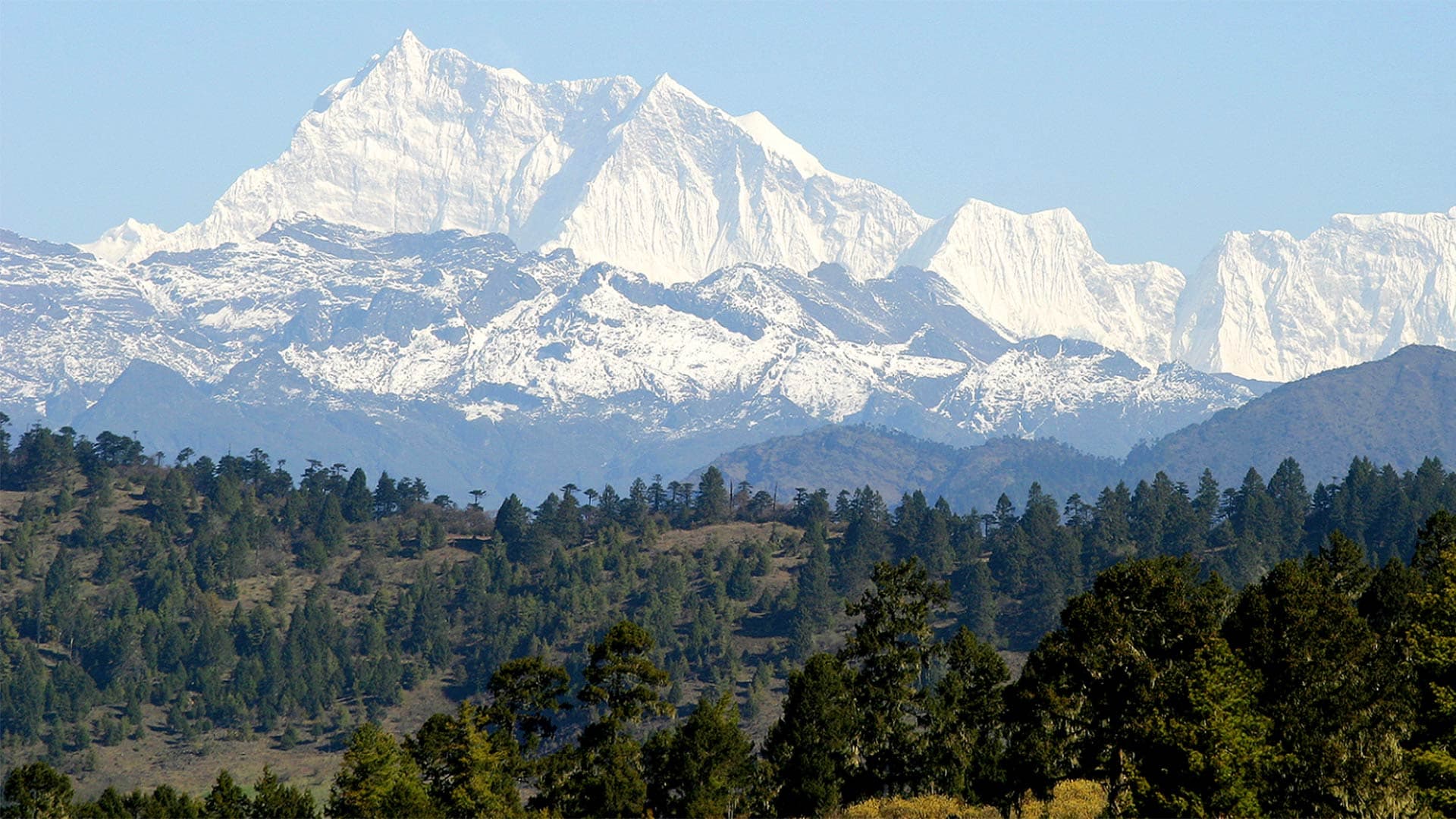
The clearest single case stands on the northern border. Gangkhar Puensum rises to 7,570 metres and is the highest unclimbed mountain on earth. It is unclimbed not because it is unclimbable but because Bhutan prohibited mountaineering on its high peaks out of respect for the deities understood to reside there. A country in possession of a genuinely unique global asset, in an era where every other Himalayan state monetised its summits aggressively, elected to leave it alone. It has done so for over thirty years and shows no sign of reconsidering.
Set the SDF against that record and it stops looking like an unusual tax. It looks like the same decision, applied to visitors instead of mountains: an asset deliberately underexploited, at a measurable cost to the exchequer, on the reasoning that the thing itself is worth more intact.
None of this makes Bhutan a country without contradictions. It is modernising quickly, it is arguing internally about what kind of economy it wants, and the restraint is a policy choice under continuous pressure rather than a settled national temperament. But the record is long and the direction has been consistent, and the fee belongs to it.
What the Hundred Dollars Actually Buys
Consider the counterfactual honestly, because it is the strongest argument available and it does not require anyone to feel good about paying.
Remove the fee. Bhutan sits between the two most populous countries on earth. It has one of the most photogenic landscapes in Asia, a living Buddhist culture in continuous practice, and a monastery on a cliff face that is among the most recognisable images in travel. There is no plausible version of this country, without a deliberate price filter, that does not receive many multiples of its current visitor numbers within a decade.
Everything that makes the place worth the journey would be the first casualty. Taktsang would be a queue. The inner chapels would close to visitors, as they have elsewhere, because the volume would make access unmanageable and the caretakers would stop opening doors. The absence of hurry described elsewhere in these pages would not survive contact with mass arrivals.
So the fee is not a contribution to a fund. It is the mechanism that maintains the conditions you came for, and it works precisely because it is blunt and non-negotiable. No operator can discount it, which is worth knowing when assessing anyone who implies otherwise.
The phrasing in the title is not a flourish. This is a country that has priced its own scarcity, chosen to forgo the revenue that abundance would generate, and made the decision structural rather than aspirational. You are being charged to slow down, and the charge is what ensures there is still somewhere slow to arrive at.
Figures in this essay are current at the time of writing and the present rate is fixed to a stated date. Government levies are set by the Department of Tourism and revised periodically, and we confirm exact figures in writing for the dates of any journey we plan.
Ogyen & Co designs bespoke private journeys through Bhutan for very few guests each year. We quote the fee, the visa and the land arrangements as separate line items rather than folding them into a single figure, because a guest is entitled to see what is a government levy and what is our work. We welcome correspondence by arrangement only.
We try to design journeys that honour that distinction. We keep our numbers small because Bhutan asked us to.
About Ogyen & Co
Ogyen & Co is a licensed private tour operator based in Thimphu, designing bespoke journeys through the Himalayan Kingdom of Bhutan for a small number of guests each year. Single departures only, by arrangement.
ogyen.co · Private journeys · Travelogues · Enquire · hello@ogyen.co