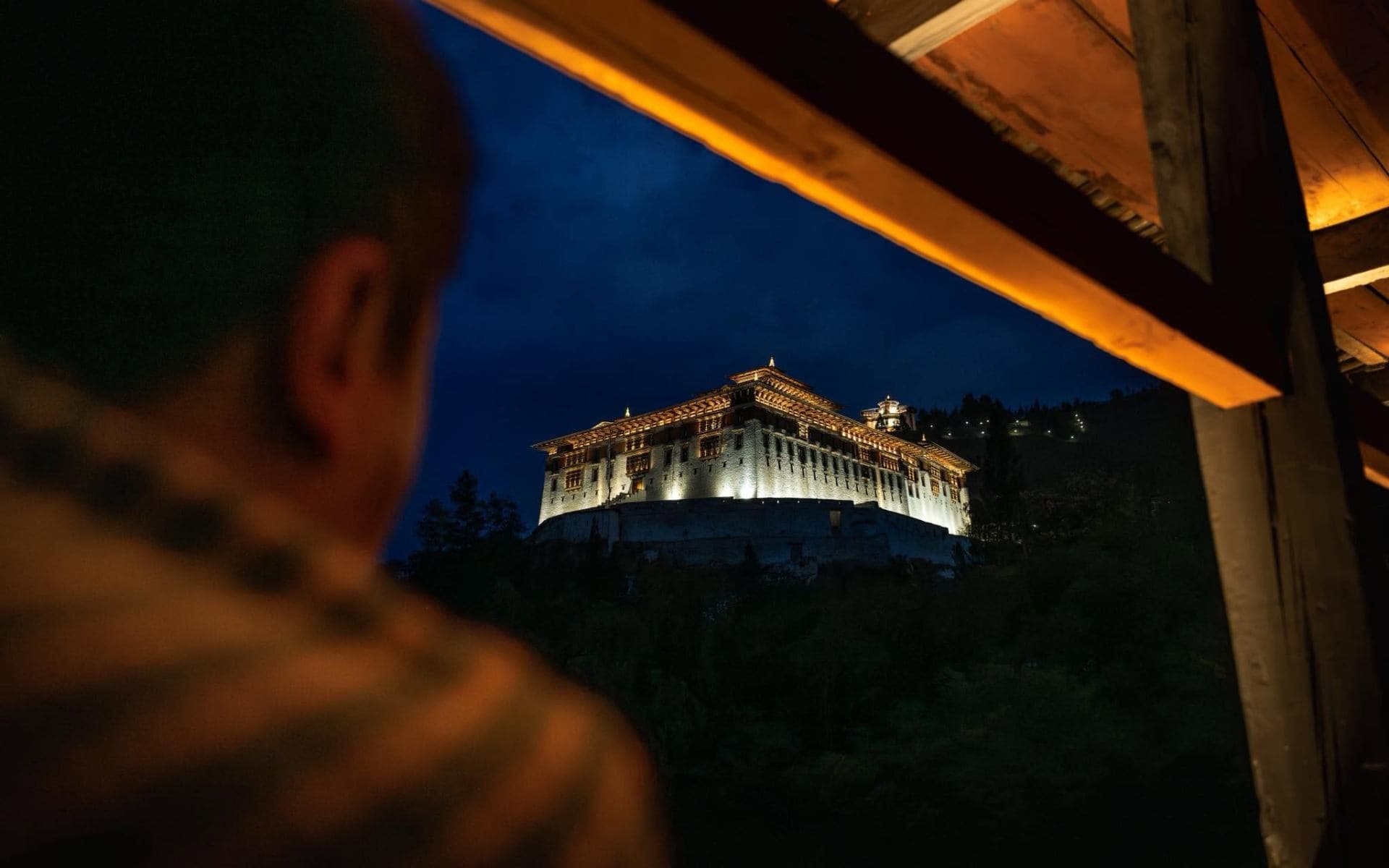
There is a particular quality to Bhutan in spring that arrives before you have found the words for it. The air at Paro's altitude carries a coolness that the sun has not yet burned away, and the hillsides above the valley floor are doing something extraordinary: turning colour in layers, from the white-flowering plum orchards at the base through the pink and crimson of the rhododendrons ascending toward the tree line, and above them, where the altitude steepens, the deep magenta of varieties that bloom only where almost nothing else will grow. It is not spectacle in the way that word is usually meant. It is more like arriving to find a conversation already in progress, one you did not know you had been waiting to join.
Bhutan spring travel draws more visitors than any other season, and rightly so. But the reasons most guides give — good weather, the rhododendrons, the festivals — are true without being complete. Spring in Bhutan is worth understanding properly.
What the Light Does in March
March in Bhutan has a quality of light that photographers and painters tend to recognise before anyone else does. The winter haze has cleared, the sky at altitude runs to a deep, particular blue, and the angle of the sun at this latitude gives everything a three-dimensional quality — a sharpness of shadow and edge — that the flatter light of summer does not produce.
At Kyichu Lhakhang in Paro, one of the oldest temples in the Himalayan world, built in the seventh century by the Tibetan king Songtsen Gampo, the morning light in March falls across the whitewashed courtyard walls in a way that makes the ochre and crimson painted borders appear almost to glow from within. The temple itself predates Bhutan's organised statehood. To stand in its courtyard in March light, before the day has fully assembled itself, is to feel the fourteen centuries of sovereign continuity that underlie everything distinctive about this country.
By late March, the rhododendrons at mid-altitude, between roughly 2,500 and 3,500 metres, are in full colour. Bhutan has more than forty native rhododendron species. This is not a botanical footnote. Walking through a Bhutanese forest in late March, when the canopy overhead is doing things that no temperate forest does, is an experience of a genuinely different order.
It is more like arriving to find a conversation already in progress — one you did not know you had been waiting to join.
The Festival Calendar and What It Means to Attend
April brings the Paro Tsechu, and it is the most widely attended festival in the Bhutanese calendar, which means it is also the most written about and the most frequently included in group tour itineraries. This is worth naming directly, because how you attend a tsechu matters as much as whether you attend.
A tsechu is a religious festival, not a cultural performance. The masked dances, the thangkas unfurled from the dzong walls at dawn, the crowds of Bhutanese who have travelled from surrounding villages in their finest gho and kira: none of this is organised for the visitor. It exists because it has always existed, and because the Bhutanese believe its performance accumulates merit for the entire community.
The traveller who arrives at the Paro Tsechu with a private guide who has a genuine relationship with the dzong administration experiences something categorically different from the one who arrives as part of a coach group. Positioning, timing, access to spaces that are not cordoned off for tourists, the ability to pause and ask a question and receive an honest answer rather than a rehearsed one: these are not small advantages. They determine whether you witness the festival or merely observe it from its edges.
April Into May: The High Valleys Open
As April moves toward May, the passes between valleys that were closed or difficult in winter begin to open. The Phobjikha valley, which in winter hosts the black-necked cranes that migrate from the Tibetan plateau, is a different place in spring: the wetlands turn green with a speed that feels almost theatrical, and the valley's particular quality of silence — which is not emptiness but rather the absence of interference — deepens as the season warms.
May is the month in which Bhutan spring travel begins to show its fullest range. The lower valleys are warm, the higher trails are accessible, and the quality of walking, whether a half-day through rice paddies or a multi-day route through rhododendron forest, is at its annual peak. The light has softened slightly from March's sharpness, the days are long, and the evenings in Punakha or Bumthang carry a warmth that invites the kind of unhurried dinner conversation that is one of the underestimated pleasures of a well-designed journey.
The Paro Tsechu is not comprehensible from the back of a crowd. The light that makes March mornings at Kyichu Lhakhang so extraordinary is gone by nine.
What Spring Asks of the Traveller
Spring in Bhutan rewards a particular kind of attention. It is not a passive season. The rhododendrons are not visible from a vehicle window. The Paro Tsechu is not comprehensible from the back of a crowd. The quality of light that makes March mornings at Kyichu Lhakhang so extraordinary is gone by nine in the morning and does not return.
The traveller who gets the most from this season is the one who has planned not just where to go but when, each day, to be where. That kind of planning requires a guide who knows the country in the way that only years of relationship produce, and an itinerary that is built around the guest's pace rather than a fixed schedule. It requires, in short, the kind of private journey that treats time as a serious material.
The Bhutan rhododendrons are reason enough to come. The light, the festivals, the opening of the high passes, and the particular quality of spring air at altitude are reasons to stay longer than you planned.
An Invitation for Those Considering Spring
Ogyen & Co designs bespoke private journeys through Bhutan for very few guests each year. Spring is our most requested season, and we begin conversations about spring departures well in advance of the season itself. If you are considering visiting Bhutan in March, April or May and would like to discuss the shape of a journey, we welcome correspondence by arrangement only.
We try to design journeys that honour that distinction. We keep our numbers small because Bhutan asked us to.
Begin a correspondence