Every other luxury is something added.
The suite is larger. The car arrives earlier. The chef cooks off menu, the guide has been briefed, the flowers were flown in, the terrace faces the correct direction at the correct hour. The entire apparatus of the industry is built on addition, and it is measurable, which is why it is sellable. A guest can count what they received.
Stillness is the only thing in the category whose value comes entirely from subtraction. Nothing arrives. Nothing is provided. What has been removed is the requirement to be anywhere, and what remains is a person with an afternoon and no account to give of it.
This is extremely difficult to sell and considerably more difficult to deliver, and the reason is the same in both cases: the guest's first instinct, on encountering it, is that they are being underserved.
The Only Luxury That Is Subtracted
Consider what an operator has to do to produce a genuinely open afternoon.
The itinerary must be built with enough margin that nothing needs to be recovered later. The drives on either side have to be short enough that the afternoon is not consumed by arrival. The property must be one where an unstructured afternoon is pleasant rather than confining. The guide has to be briefed to offer nothing unless asked, which is against every instinct he has been trained with. And the guest has to have been prepared, weeks in advance, to understand that this day was designed rather than left over.
That is more work than programming a full day, not less. Anyone can fill an afternoon. Filling it requires only a list of sites and a driver.
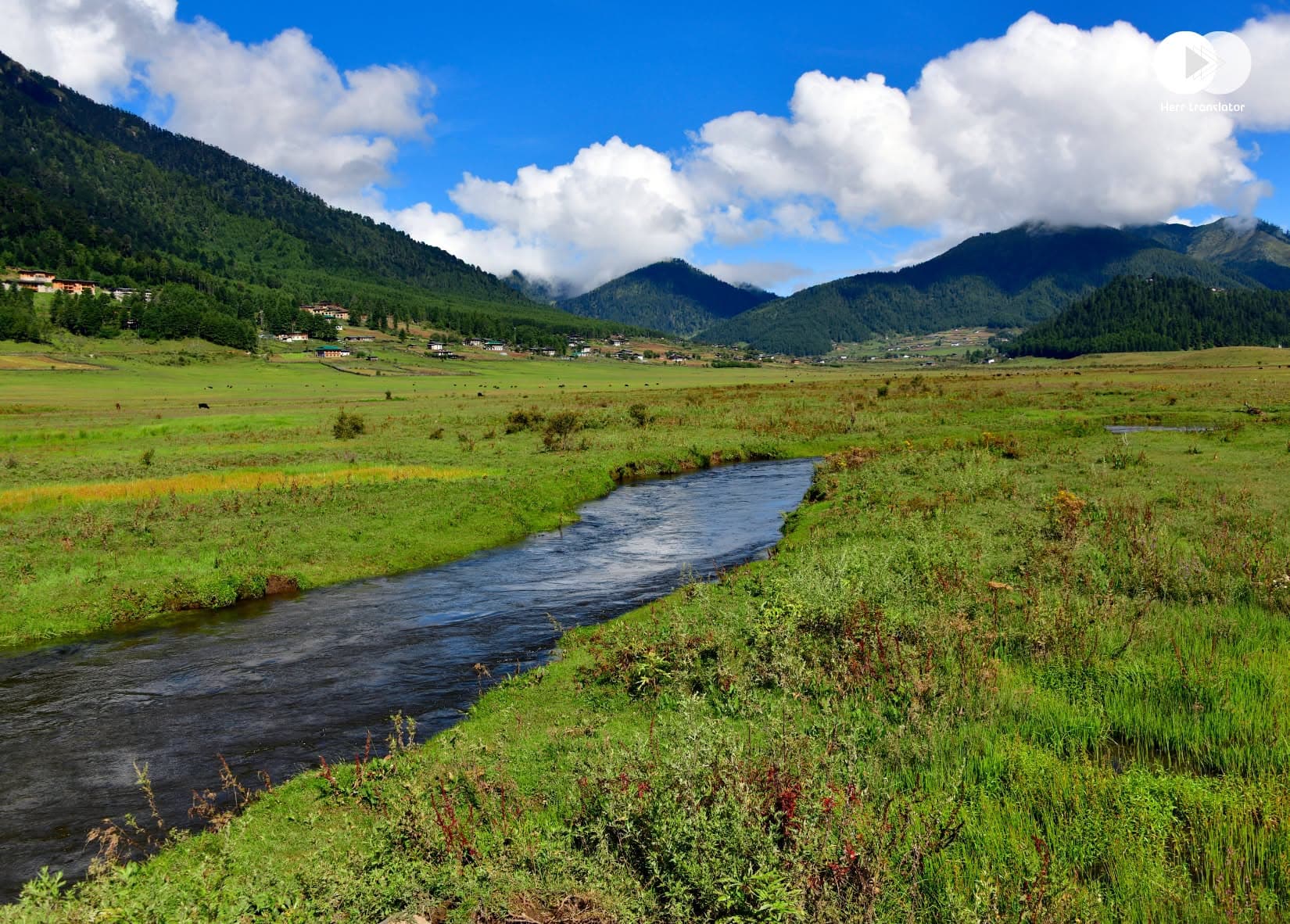
The commercial problem is that the effort is invisible. A guest who receives four temples can point at four temples. A guest who receives an open afternoon at Gangtey with the correct weather and the correct amount of nothing has received the more expensive thing and has no way to see the cost. Most operators resolve this tension in the obvious direction, which is why almost every Bhutan itinerary in circulation is overfull, and why the guests on them come home describing a country they experienced mostly through a car window between scheduled stops.
We resolve it in the other direction, and we lose some enquiries because of it. That is an acceptable trade, but it is a real one and worth stating rather than dressing up.
A Retreat Is a Bubble. Bhutan Is a Country.
The wellness industry solved the stillness problem some time ago, and it solved it with architecture.
Build a compound. Control what enters it. Take the phones at reception, or ask guests to surrender them voluntarily, which works better. Remove the televisions, restrict the wifi, set the meal times, fill the day with a schedule of therapies that occupies the guest sufficiently that they do not notice they have nothing to think about. The result is genuinely effective, and the good ones are very good.
But it is a manufactured interior inside a country that has not changed. The guest steps out of the gate and the traffic is there, the noise is there, the pace is there. The stillness was a bounded exception, and everyone involved knows it, which is why the last morning of a retreat carries the particular anxiety it does. The thing was always going to end at the property line.
This is the structural difference between a bhutan luxury wellness retreat, of which this country now has several and some are excellent, and a journey through Bhutan itself. In the second case there is no property line. The slowness is not being maintained by the operator against the surrounding conditions. It is the surrounding conditions.
And it is enforced by friction rather than philosophy, which is the part that gets romanticised and shouldn't be. There is one international airport and the flights into it are few and weather dependent. The Sustainable Development Fee applies to every night and prices out the volume that would otherwise arrive. The roads are mountain roads and the drive between two valleys takes the time it takes, regardless of what the guest is willing to pay. Nothing much is open late. In most of the country there is no version of the evening that involves going out.
None of this was arranged for the benefit of visitors seeking calm. It is the consequence of terrain, policy and a small population, and the effect on a guest's nervous system is entirely incidental. That is precisely why it works. Manufactured stillness is something the guest is participating in. Structural stillness is something they are simply inside of, and the difference is legible to the body within about four days.
Busyness Is Not Hurry
Here the essay has to be careful, because the cliché is close and the cliché is false.
Bhutan is not a country of people sitting quietly. It is a modernising state moving quickly in several directions at once. Thimphu has construction sites and traffic and considerable frustration about both. The government is building a mindfulness city at Gelephu on a scale that would be ambitious for a country ten times the size, holds sovereign digital assets, and is arguing internally about what kind of economy it wants. A very large number of young Bhutanese have left for Australia in the last few years, and the conversations about why are neither serene nor resolved. Farmers work hard. Civil servants work long. The idea that this is a nation at rest is a projection that visitors bring with them and that nobody here has much patience for.
What is genuinely different is not the quantity of activity. It is the near total absence of hurry, which is a separate variable and rarely distinguished from the first.
Hurry is what happens when a person believes that the speed of their movement affects the outcome. It requires a particular relationship with time in which every interval is an input to something, and is therefore wasted if not converted. Bhutan is full of busy people who do not appear to hold this belief. The work gets done at the pace the work takes. Meetings begin when the participants have arrived. A drive takes four hours and no one performs impatience about it, because performing impatience does not compress mountains.
Some of that is Buddhist cosmology operating at a background level, in a culture where the relevant timescale for anything important is not a lifetime. Some of it is simply what happens in a place where the physical constraints are immovable and everyone has grown up knowing it. A traveller does not need to adopt the cosmology to feel the effect. They need to spend nine days somewhere where their own hurry produces no results and receives no reinforcement, at which point it starts to look like the strange habit it is.
Even the traffic lights are a version of this. Thimphu is described everywhere as the only capital with none, and the fact is usually offered as charm. The actual history is that lights were installed and then removed, because people preferred the policeman in the box directing traffic by hand. It is slower. Everyone knows it is slower. It was kept anyway.
The Difference Between an Empty Day and an Open One
The failure mode of everything argued above is real and we should name it, because guests encounter it on day three.
An unstructured day is not automatically restful. For a certain kind of traveller, and it is frequently the most successful and capable ones, an afternoon with nothing in it produces restlessness within about ninety minutes, then irritation, then the quiet conviction that the itinerary has failed them. They did not come this far to sit. The mind that arrives in Bhutan has been running at a particular speed for years and does not decelerate because the surroundings have changed.
The amateur version of what this essay describes is an itinerary with gaps in it. Free afternoon, no plan, guest left at the property. That produces boredom, and boredom is not stillness. It is the same restlessness with nothing to push against.
The designed version is different in ways that are hard to see on paper. The open time is placed where the body will actually use it, which is usually after the altitude has been absorbed and before the longest drive rather than distributed evenly. There is always something available and never anything expected, and the guide understands the distinction precisely. The location matters enormously: an open afternoon at a river lodge in Punakha and an open afternoon in a Thimphu hotel are not the same product. And the guest has been told beforehand, in writing, that day five is deliberate, because a guest expecting emptiness experiences it as design and a guest surprised by it experiences it as neglect.
Done properly, the restlessness still arrives. It is supposed to. What changes is that it arrives inside a structure where it has somewhere to go, and it burns off in an afternoon rather than souring the week.
Where the Body and the Mind Stop Being Separate Categories
The argument this series has been circling for some time can now be stated directly.
Everything in Bhutan that actually works on a visitor operates on the same principle, and the principle is duration rather than intensity.
The blessing accumulated in an ancient temple is not conferred by arrival; it requires enough time in the room for anything to register. The medicinal springs at Gasa are attended for days, not hours, because the tradition holds that efficacy is a function of how long the conditions are sustained. Acclimatisation proceeds on its own timetable and ignores every input except elapsed time at height. The traditional medical system prescribes across seasons. The meditation instruction a Bhutanese lama gives is almost never about technique and almost always about continuing.
One theory of change, applied identically to the mind and to the body, because the tradition never divided them in the first place.
The Western wellness market divides them constantly, and for administrative reasons rather than philosophical ones. Spiritual experiences are sold by one department and physical treatments by another. The retreat has a meditation programme and a spa menu, and they are separate line items with separate practitioners and separate rooms. It is a workable arrangement commercially and an incoherent one intellectually, and it produces the specific hollowness that thoughtful guests report after this kind of holiday, where a great deal happened and nothing quite connected.
What Bhutan offers is not a better version of that arrangement. It is a country organised around the assumption that the arrangement is wrong, in which the same slow logic governs a temple, a hot spring, a mountain pass and a conversation, and in which a guest given enough undisturbed time is subject to all of it at once without anyone having to programme the connection.
Having nowhere to be is the mechanism by which that becomes available. It is the least visible thing on an itinerary and the only one that determines whether the rest of it works.
Ogyen & Co designs bespoke private journeys through Bhutan for very few guests each year. The open days in our itineraries are placed deliberately and defended when clients ask us to fill them, which they often do at the planning stage and rarely do afterwards. We welcome correspondence by arrangement only.
We try to design journeys that honour that distinction. We keep our numbers small because Bhutan asked us to.
About Ogyen & Co
Ogyen & Co is a licensed private tour operator based in Thimphu, designing bespoke journeys through the Himalayan Kingdom of Bhutan for a small number of guests each year. Single departures only, by arrangement.
ogyen.co · Private journeys · Travelogues · Enquire · hello@ogyen.co