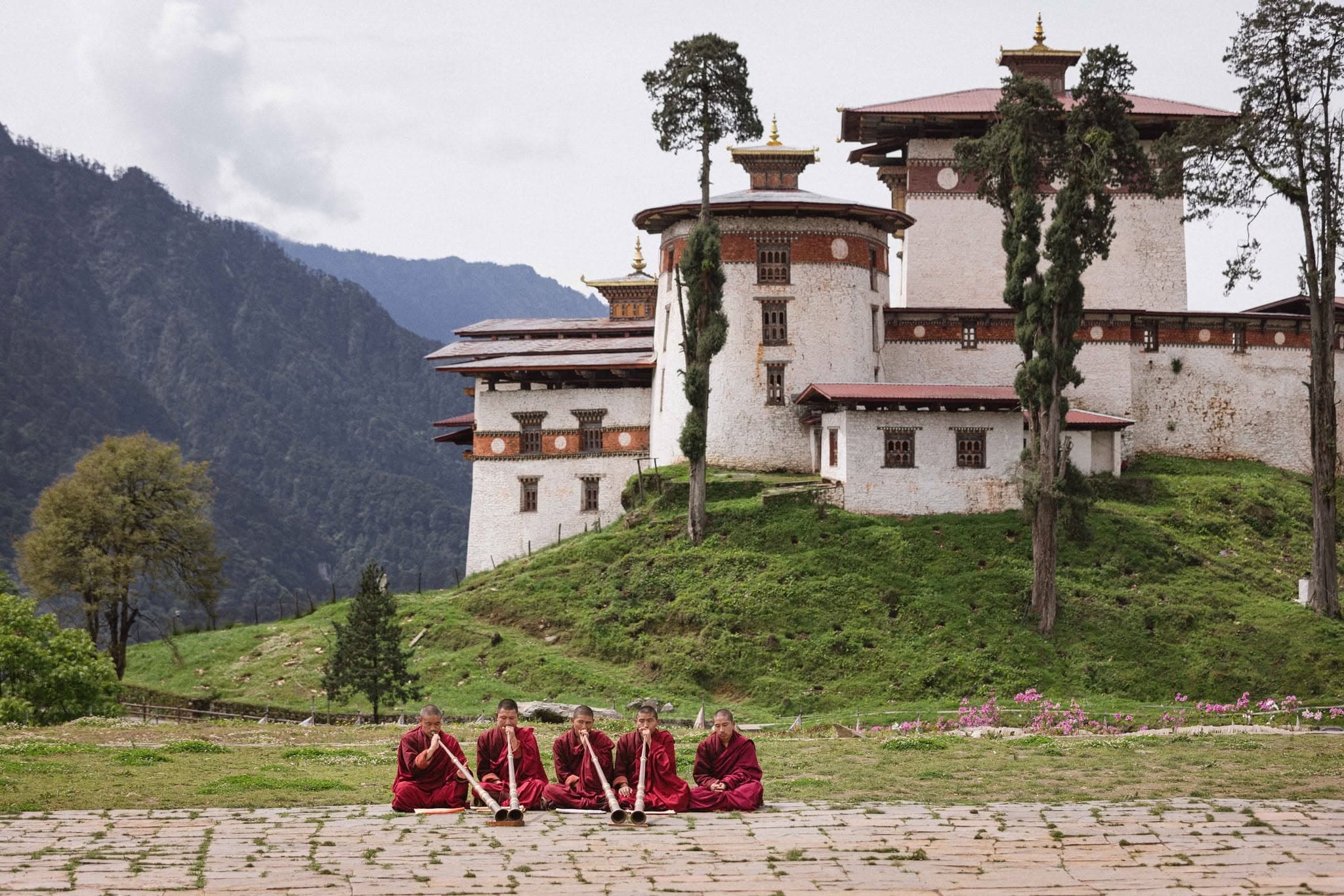
There is a particular kind of traveller who has done the retreat. They have sat in silence in Ubud or Tuscany or the hills above Cape Town, followed the breath, attended the sessions, and returned home feeling, for a week or perhaps two, noticeably different. Then ordinary life reassembled itself around them, and the clarity they carried back from the cushion dissolved into the texture of their usual days. This is not a failure of the retreat. It is the nature of an experience that was designed, however beautifully, as an interruption.
Bhutan is not an interruption. It does not offer a programme that brackets ordinary life for seven days and returns you to it rested. What it offers is something harder to package and considerably more durable: an encounter with a civilisation that has practised contemplation not as a wellness modality but as the organising principle of its entire cultural architecture, for over fourteen centuries, without pause. The bhutan meditation retreat framing misses something essential about what the kingdom actually provides. Bhutan does not call what it does meditation. It calls it life.
That distinction is worth sitting with before you plan the journey.
What Contemplation Looks Like When It Is Not a Product
The bhutan private spiritual guide who has worked in the kingdom for long enough will tell you something that takes visitors a moment to absorb: there is no separation, in Bhutanese daily life, between the contemplative and the practical. The monk who rises at four in the morning to recite the liturgy is not interrupting his day for spiritual practice. The liturgy is the day's first task, as concrete and as necessary as the farming that follows it in the valley below.
This non-separation is visible everywhere, once you know to look for it. The water-driven prayer wheels along the Thimphu River turn continuously, day and night, accumulating merit through the simple fact of the water's movement. The incense burning in the small altar room of a farmhouse is not an occasional gesture toward the sacred. It is a daily act of maintenance, as routine as cooking. The butter lamps that line the inner shrines of every lhakhang are tended by someone whose relationship with that act of tending is measured in decades rather than retreat weekends.
The traveller who moves through Bhutan with genuine attention begins to absorb this not as an intellectual proposition but as a felt reality. Something in the rhythm of the country begins to work on the rhythm of the person moving through it. This is not mysticism. It is what happens when you spend enough days inside a culture that has organised itself around a different relationship with time and interiority than the one you arrived from.
The Landscape as Contemplative Technology
Bhutan's terrain is not incidental to its contemplative tradition. The beyul doctrine, the sacred geography in which Guru Rinpoche consecrated specific valleys as places of spiritual power in the eighth century, means that the landscape and the practice are understood as inseparable. You do not go to Bhutan and find meditation there. You move through a landscape that was understood, for over a thousand years before the word wellness existed, as inherently conducive to the turning of the mind inward.
The Phobjikha valley in winter demonstrates this with particular force. The valley is broad and bowl-shaped, ringed by forested hills, and in the months when the black-necked cranes have arrived from the Tibetan plateau, it carries a quality of stillness that is not simply the absence of noise. It is a positive quality, a presence rather than a lack, and the traveller who spends two nights there rather than the customary one begins to feel it in a way that a single afternoon does not allow.
The walk to Gangtey Goenpa, the monastery that sits above the valley floor, takes less than an hour and involves no technical difficulty. What it involves is the gradual relinquishment of the pace you arrived with. The path does not permit hurrying in any meaningful sense. The altitude, modest by Bhutanese standards, insists on a slower breath. By the time you reach the monastery courtyard, something has already begun that no programme scheduled it.
Why the Silence Here Is Different
Every serious bhutan meditation retreat operator will offer you silence. Silence in Bhutan is of a different quality, and the difference is not atmospheric. It is historical.
In a country that has never been colonised, never absorbed, never required to adapt its inner life to an outside power's expectations, the silence is not the absence of noise in a place that is usually noisy. It is the presence of a continuity that has not been interrupted. The monk sitting in the courtyard of Tango Monastery above Thimphu is sitting in a lineage of practice that connects him, without break, to the teachers who founded that institution in the twelfth century. The silence around him carries that continuity. It is not empty. It is full of something that takes a few days to begin to hear.
This is what no retreat centre, however beautifully designed and however expertly staffed, can manufacture. The silence of a wellness retreat is created. The silence of a Bhutanese monastery is accumulated. The traveller who has experienced both knows the difference immediately, even if they take some time to find the words for it.
The Guide as the Key
The bhutan private spiritual guide is, in this context, not a service provider. They are the interpreter of a tradition that took fourteen centuries to develop and does not yield its depth to the casual visitor. The difference between a monastery visit that produces a pleasant memory and one that produces a genuine shift in understanding is almost entirely a function of who is standing beside you and what they know.
A guide who has grown up within the tradition, who has a personal relationship with the monks and the lamas whose institutions you are visiting, who can translate not just the language but the cosmology behind what you are seeing, gives you access to a layer of the country that the surface journey does not reach. They know when to speak and when to remain silent. They know which questions are worth asking and how to ask them. They know, crucially, when to step back entirely and allow the place to do its own work.
This kind of guide is not available through a booking platform. They are available through a relationship with an operator who has spent years building the kind of trust within Bhutan that makes the introduction possible.
What You Carry Home
The guest who travels Bhutan with genuine contemplative intention does not return from a retreat. They return from an encounter with a civilisation that chose, at every point where it could have chosen otherwise, to keep the inner life central. That encounter does not dissolve back into ordinary life in the way that a programme does. It changes the quality of the ordinary, subtly and in ways that accumulate rather than fade.
Ogyen & Co designs bespoke private journeys through Bhutan for very few guests each year. For guests whose interest in the kingdom is shaped by a contemplative dimension, we build the journey around that interest as its structural centre, pairing the itinerary with guides whose knowledge of the living tradition goes well beyond the standard route. If this is the kind of journey you are considering, we welcome correspondence by arrangement only.
We try to design journeys that honour that distinction. We keep our numbers small because Bhutan asked us to.