Most people who ask when to come to Bhutan have already been told the answer. It is October, or perhaps April, and the reasoning is sound: the monsoon has cleared or has not yet begun, the skies over the Himalaya are at their most legible, and the festival calendar is full. The guidebooks agree, the operators agree, and the airlines, which raise their fares accordingly, agree most of all.
We do not dispute the answer. We dispute that it is an answer to the right question.
The best time to visit Bhutan depends less on weather than on what the traveller intends to do with it. A kingdom that rises from roughly 200 metres in its southern foothills to more than 7,000 metres at its northern border does not have a season so much as several running at once, stacked by altitude. The month is not a setting you choose once. It is the first decision in a design, and every later decision inherits it.
What the Rain Actually Does
The figures are worth stating plainly, with the usual caveat that they are averages and the mountains do not read them. In the western valleys of Paro and Thimphu, rainfall runs to around 25 mm a month in winter, climbs through spring, and then arrives in earnest: in the region of 350 mm in July and 300 mm in August, falling to perhaps 125 mm in September, 75 mm in October and close to nothing by December.
The monsoon, then, is real, and the case against it is not only about comfort. Roads between valleys are cut into mountainsides and they slip. The high passes, Dochu La above all, are often inside the cloud rather than above it, so the Himalayan range that justifies the stop is simply absent. Flights into Paro, which depend on visual approach, are delayed more often.
And yet. The summer valleys are the greenest they will be all year, the rice terraces of Punakha are flooded and luminous, and the visitor numbers are low enough that a dzong courtyard at mid-morning can hold no one but the monks. For a returning guest who has already seen the peaks, July in Bhutan is a different country, and not a lesser one. We do not recommend it for a first journey. We would not rule it out for a second.
Autumn, and the Problem With Consensus
From late September to November the sky is the reason people come. The air is dry, visibility across the range is at its longest, and the Thimphu Tshechu, typically held in September or October, fills the capital's dzong with masked dances that have been performed in the same sequence for centuries.
This is the season every itinerary is built for, and so it is the season in which every itinerary collides. The same lodges are full. The same trail to Taktsang carries the same groups at the same hour. The festival courtyard at Thimphu, which is a religious event before it is a spectacle, holds more cameras than the ritual was designed to absorb.
October remains the right choice for a first journey. It is right for the light and the air and the clarity, and wrong only if it is booked the way everyone else books it. The difference lies in small adjustments: starting the Taktsang ascent before six in the morning rather than after nine, placing the guest in the eastern valleys when the western ones are most crowded, or holding the festival not in the courtyard but at the lodge, where monks can perform the dances privately as they would at a tshechu. The season is not the problem. Consensus is.
Winter, Which Is Underrated
December to February is the season we are most often asked to justify, and the one we find easiest to defend.
The cold is real at altitude. Paro and Thimphu drop below freezing at night, and Bumthang, higher and further east, is colder still. But the days are frequently clear and bright, and the views from the passes in January are often better than in October, because the air holds even less moisture.
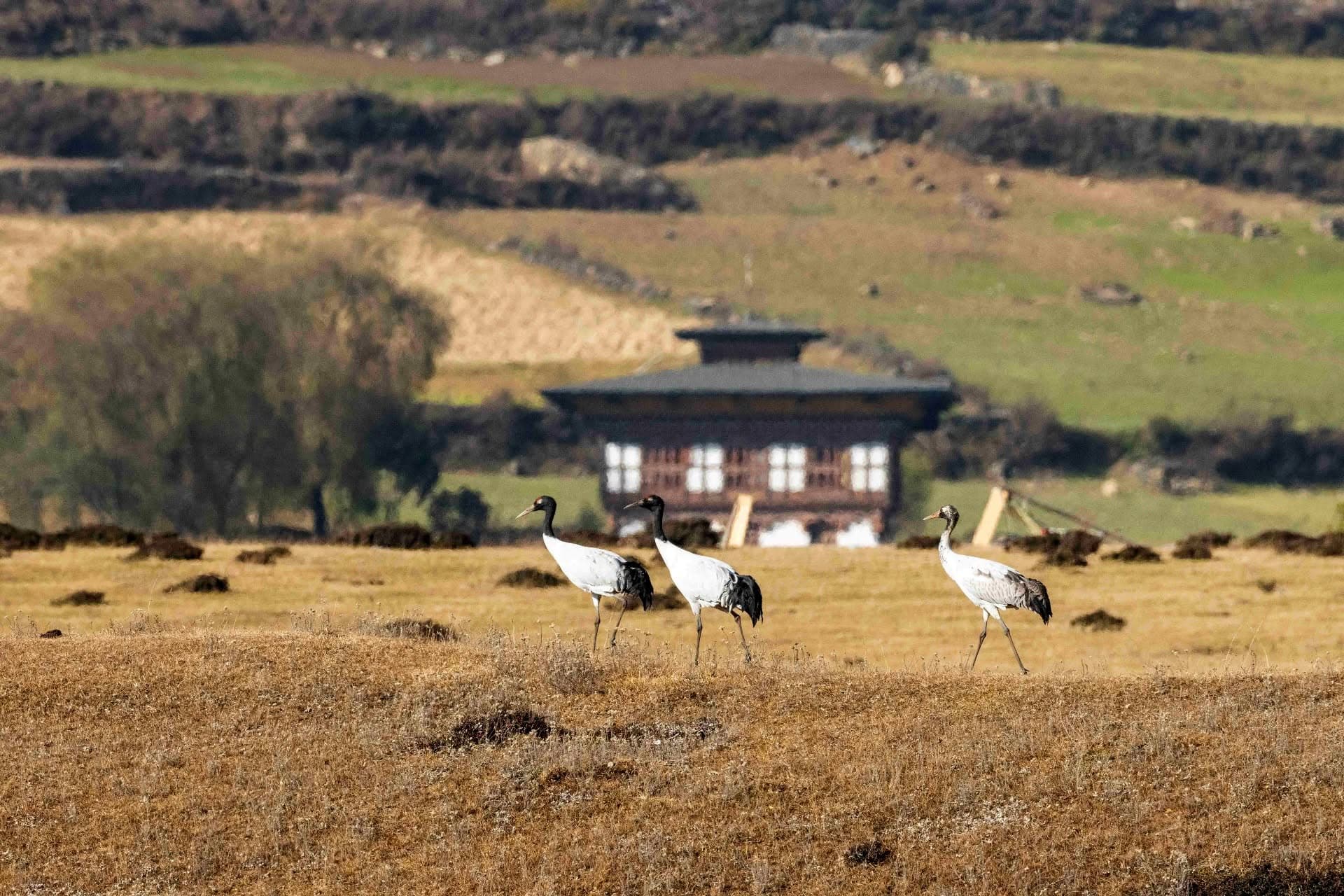
More importantly, winter is when Punakha comes into its own. At roughly 1,200 metres the valley is warm enough for lunch outdoors in January, and it has long served as the winter seat of the central monastic body, which moves down from Thimphu each year. Further up, in the glacial valley of Phobjikha, the black-necked cranes arrive from the Tibetan plateau in late October and remain until around March. The Gangtey Goenpa above the valley marks their arrival with a festival in November, and the local understanding is that the birds circle the monastery three times on arrival and again on departure.
A winter journey in Bhutan is quieter, colder at night, warmer in the lower valleys than people expect, and far less contested. It asks for better planning and returns more solitude.
Spring, and the Case for the Passes
March to May has its own argument, and it is botanical. The rhododendron forests on the high passes flower in sequence as the season climbs, red and then pink and then white, and in Punakha the jacaranda trees around the dzong bloom lilac against the whitewashed walls. The Paro Tshechu, usually in March or April, closes with the unfurling of a great thangka before dawn, an image so large it is shown only once a year, briefly, before the sun can touch it.
The trade-off is haze. Spring skies are softer than autumn ones, and the long views across the range are less reliable. A guest who wants the mountains above everything should come in the autumn or the depths of winter. A guest who wants the kingdom in bloom should come now.
The Question Behind the Question
The honest answer to when is another question: what is the journey for.
If the purpose is the range itself, the answer is October, November or January. If it is the festivals, the dates move with the lunar calendar each year and must be confirmed before anything else is planned. If it is the cranes, it is November to February. If it is solitude, it is winter or the early monsoon. If it is the first time, it is autumn, booked with care.
What no season can do is compensate for an itinerary built without regard to it. The kingdom rewards the traveller who arrives at the right altitude in the right week, and quietly penalises the one who arrives everywhere at once.
Ogyen & Co designs bespoke private journeys through Bhutan for very few guests each year. We begin every journey with the month, because in this country the month decides the route, the lodges, the hour each day begins, and what the guest is likely to see when they look up. Seasonal figures and festival dates change and are confirmed in writing for each journey. We welcome correspondence by arrangement only.
We try to design journeys that honour that distinction. We keep our numbers small because Bhutan asked us to.
About Ogyen & Co
Ogyen & Co is a licensed private tour operator based in Thimphu, designing bespoke journeys through the Himalayan Kingdom of Bhutan for a small number of guests each year. Single departures only, by arrangement.
ogyen.co · Private journeys · Travelogues · Enquire · hello@ogyen.co