Most destinations can be reached without thinking about it. Bhutan cannot, and a good deal of travel writing treats this as an inconvenience to be managed: limited flights, a single airport, a visa that cannot be obtained alone. We would rather describe it accurately, because the difficulty is not incidental to the country. In a quiet way it is the country's first act of design.
One Runway
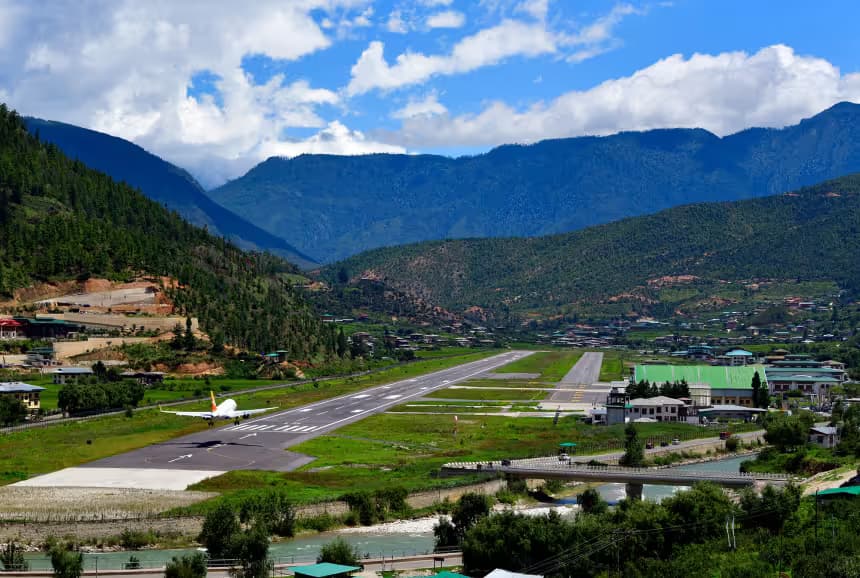
Paro International Airport is the kingdom's only international gateway by air. It sits in a valley floor at around 2,200 metres, enclosed by ridges that rise far higher on every side, and the final approach is flown by sight, weaving down the valley before the runway appears. Only a small number of pilots are certified to land there. Flights operate in daylight, and weather can hold them on the ground elsewhere.
Two carriers fly in: Drukair, the national airline, and Bhutan Airlines. Routes connect Paro with a handful of regional hubs, Bangkok, Delhi, Kathmandu and Singapore among them, with the precise schedule changing by season. For most guests from Europe, the Americas or the Gulf, the practical route is an overnight in Bangkok or Delhi, then the morning flight in.
The flight from Kathmandu deserves a particular note. On a clear morning it runs along the Himalayan range, and a seat on the left side of the aircraft offers a view that includes Everest. We try to route guests through Kathmandu when the season favours it, for that reason alone.
The Visa, Plainly
The Bhutanese tourist visa is not complicated, but it cannot be obtained in the usual way.
There is no embassy appointment and no stamp in advance. The licensed operator applies on the guest's behalf, using a clear scan of the passport, which must remain valid for at least six months beyond the date of departure from Bhutan, a recent photograph, and proof of travel insurance. The one-off visa fee is USD 40 per person, and the Sustainable Development Fee for each night is paid as part of the same application. Approval usually comes within a few working days as a clearance letter, and the visa itself is stamped into the passport on arrival.
For most nationalities this is the whole of it. Guests from India, Bangladesh and the Maldives follow different arrangements, and anyone arriving overland enters through the southern border towns of Phuentsholing, Gelephu or Samdrup Jongkhar rather than Paro.
What the Difficulty Does
Here is the concession. Reaching Bhutan takes longer than it should, costs more than equivalent regional flights, and depends on weather that no one controls. A guest with four days cannot see much of the kingdom, and a guest with rigid connections may lose one of them.
And here is the rest of it. The difficulty is also what keeps the kingdom as it is. A country that could be reached by any carrier from any hub would be a different country within a decade. The single runway, the licensed operator, the fee each night: none of these is an accident, and together they ensure that very few people arrive without having decided to.
We have come to think of the arrival as the first part of the journey rather than the last part of the logistics. The guest who lands in Paro has already chosen something.
How We Build Around It
The practical consequences are few but firm.
We plan an unhurried night at the connecting hub rather than a tight same-day transfer, so that a held flight costs an evening rather than a day. We keep the first afternoon in the kingdom light, because the arrival itself is a significant event and a body that has flown overnight to 2,200 metres deserves a gentle start. We drive directly from the airport to Thimphu, roughly an hour and a half, and leave Paro for the end of the journey, when the guest is acclimatised and the valley can be met properly.
On departure, we keep the final morning clear. Flights out of Paro leave early and occasionally leave late, and the last hours of a journey should not be spent watching the sky.
What Arrives With the Guest
The arrival matters for one more reason, which is harder to measure. A guest who has spent the approach looking at the range, rather than at a phone, lands already in the register the journey asks for. A guest who has been rushed through a tight connection lands in the register of the airport they left.
We cannot control the weather over the ridges. We can control almost everything else about the first day, and we give it more attention than any other.
Ogyen & Co designs bespoke private journeys through Bhutan for very few guests each year. We arrange the visa, the connections and the first day as one piece, so that the guest's arrival is part of what they came for. Flight routes, visa requirements and government levies change and are confirmed in writing for each journey. We welcome correspondence by arrangement only.
We try to design journeys that honour that distinction. We keep our numbers small because Bhutan asked us to.
About Ogyen & Co
Ogyen & Co is a licensed private tour operator based in Thimphu, designing bespoke journeys through the Himalayan Kingdom of Bhutan for a small number of guests each year. Single departures only, by arrangement.
ogyen.co · Private journeys · Travelogues · Enquire · hello@ogyen.co