Punakha sits lower than almost anywhere else in Bhutan, and you feel the difference before you understand it. After the altitude of Paro or the administrative briskness of Thimphu, the descent into the Punakha valley through the Dochu La pass carries you into warmer air and a wider sky, and the valley floor, when it appears below the final switchbacks, has a lushness that the higher valleys do not attempt. Rice terraces step down toward the river. Banana trees grow at the roadside. The light is softer and more gold, and the whole valley has the quality of a place that has been continuously inhabited and continuously loved for a very long time.
Punakha is not the most remote part of the kingdom. It is not the most austere or the most meditative. What it is, and what makes it indispensable to any serious Bhutan itinerary, is the place where the country's history, its landscape, its living religious tradition, and its agricultural abundance converge most visibly in one valley. To spend two nights in Punakha and understand what you are looking at is to understand something essential about Bhutan that no other valley quite provides.
The Dzong at the Confluence
Punakha Dzong stands where the Pho Chhu, the male river, and the Mo Chhu, the female river, meet. It was built in 1637 by Zhabdrung Ngawang Namgyal, the monk-ruler who first unified Bhutan as a coherent state, and it has served ever since as both a religious centre and the winter capital of the Central Monk Body, whose members descend each year from Thimphu when the seasons turn.
The dzong is, by any measure, one of the most architecturally significant buildings in the Himalayan world. Its white-washed towers rise directly from the riverbank, their reflections completing themselves in the water below, and the interior courtyards, each one leading deeper into the complex's religious heart, carry the accumulated presence of nearly four centuries of continuous occupation. It has survived flood and earthquake and fire, and each restoration has returned it to something as close to the original as living memory and traditional craft could manage.
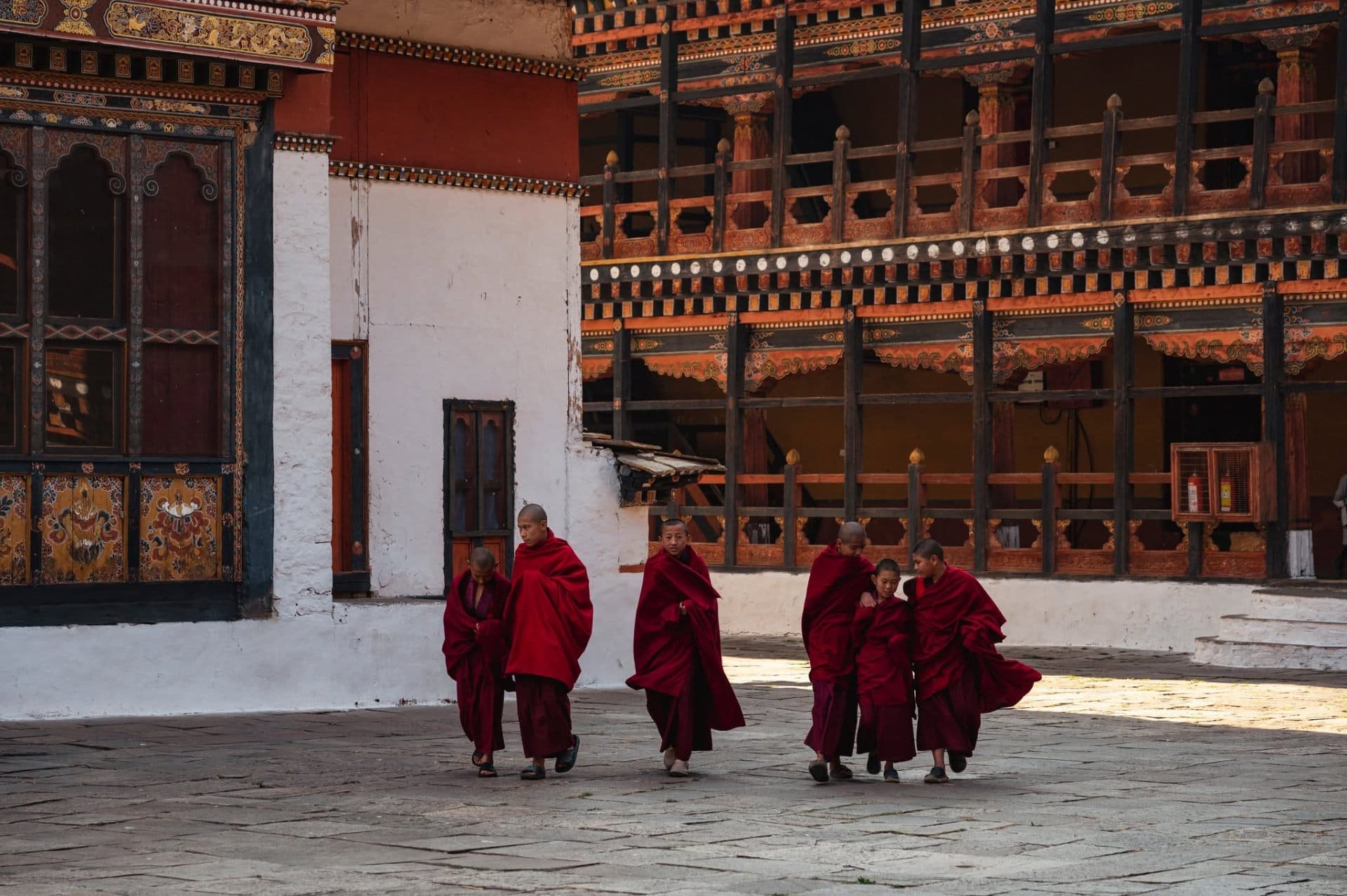
What matters to the visitor who arrives with genuine curiosity is not the architectural inventory but the atmosphere. The Punakha Dzong is not a monument. It is a working institution. The monks who live there during the winter months are not there for any reason connected to tourism. They are there because the Zhabdrung established their presence in that valley in 1637 and nothing since has interrupted the arrangement. Walking its courtyards is not a heritage experience. It is an encounter with continuity.
Walking its courtyards is not a heritage experience. It is an encounter with continuity.
The Suspension Bridge and the Valley Floor
Below the dzong, a traditional cantilever bridge crosses the Mo Chhu, and a walk along the valley floor from there becomes one of the quiet pleasures of any time spent in Punakha. The path runs between rice fields and farmhouses, past chortens painted white and weathered to a warm grey, through groves of jacaranda that in spring turn the valley floor violet. There is a suspension bridge further along that sways above the river with a confidence that requires trust, and on the far bank the trail continues into countryside that has the particular quality of a place where the only people you will meet are people who live there.
This is not a managed walk. There is no entrance fee, no guide requirement, no interpretive signage. The Punakha valley travel experience is simply the valley, doing what it does, with or without a visitor present.
The Farmhouse Lunch
One of the most quietly significant experiences a private journey through Punakha can include is lunch at a working farmhouse. This is not a cultural performance arranged for tourist groups. Done properly, through a guide with a genuine relationship with a farming family, it is an invitation into a home that operates on its own terms.
The food served at a Bhutanese farmhouse table — red rice grown in the fields visible from the window, ema datshi prepared with the heat and generosity that restaurant versions rarely match, seasonal vegetables, butter tea if you will accept it — is a version of Bhutanese daily life that no hotel kitchen can reproduce. The conversation, if your guide is the right one and the relationship is real, opens into something more honest than a scheduled cultural interaction.
This is what private travel in Bhutan makes possible: not manufactured intimacy but actual access. The Punakha Dzong is extraordinary. The lunch in the farmhouse above it, with the valley spread below and the monks descending to the river in the early afternoon, is the experience that guests remember with equal clarity years later.
Not manufactured intimacy, but actual access.
Why Punakha Anchors the Itinerary
Every serious Bhutan itinerary includes Punakha, and it should. But the valley rewards time more than almost anywhere else in the kingdom. One night in Punakha is an introduction. Two nights is a beginning. The guest who stays long enough to walk the valley floor in the morning light, visit the dzong when the tour groups have left, and return to a farmhouse for a second meal with a family that now knows their name is having a different journey from the one who ticks the dzong and moves on.
Punakha is also the valley that makes the rest of the itinerary legible. The agricultural abundance, the living monastic tradition, the architecture that serves a continuous function rather than a commemorative one: these are the things that explain why Bhutan feels the way it does, and Punakha is where they are most available to the eye and the understanding.
Arriving in the Warm Valley
Ogyen & Co is a private luxury operator based in Thimphu, fully licensed with Bhutan's Department of Tourism, designing bespoke journeys through Bhutan for very few guests each year. Punakha is a valley we know well and return to with every guest, because it earns that return. If you are considering Bhutan and would like to discuss an itinerary built around the places that genuinely matter, we welcome correspondence by arrangement only.
We try to design journeys that honour that distinction. We keep our numbers small because Bhutan asked us to.
Begin a correspondence