There is a moment that arrives, usually on the second or third day in Bhutan, that is difficult to account for by any of the usual measures of travel. You are standing in a dzong, or walking a path between painted mani walls, or watching monks cross a courtyard in the early morning, and something registers that is not quite wonder and not quite peace. It is more like recognition — the feeling of encountering something that has been entirely itself for a very long time. The word that comes, if you let it, is intact.
Most cultures that travellers encounter have been interrupted. Colonised, absorbed, reshaped for export, rebuilt after conflict, or simply worn smooth by the friction of mass tourism. Bhutan has experienced none of these things. It has maintained uninterrupted sovereignty for over fourteen centuries, through the rise and fall of empires that swept across every neighbouring territory, without ever being asked to become something other than what it chose to be. That fact is not a footnote in a history book. It is present in the air of every valley you walk through.
A Culture That Was Never Asked to Perform
The deepest consequence of Bhutan's history of sovereignty is not political. It is experiential. When a culture is colonised, or opened to mass trade, or reshaped by the requirements of an outside power, it undergoes a subtle but irreversible change: it begins to know itself as it is seen by others. It develops a performed version of itself, a face turned toward the visitor. Over generations, that performance and the reality beneath it can become nearly indistinguishable.
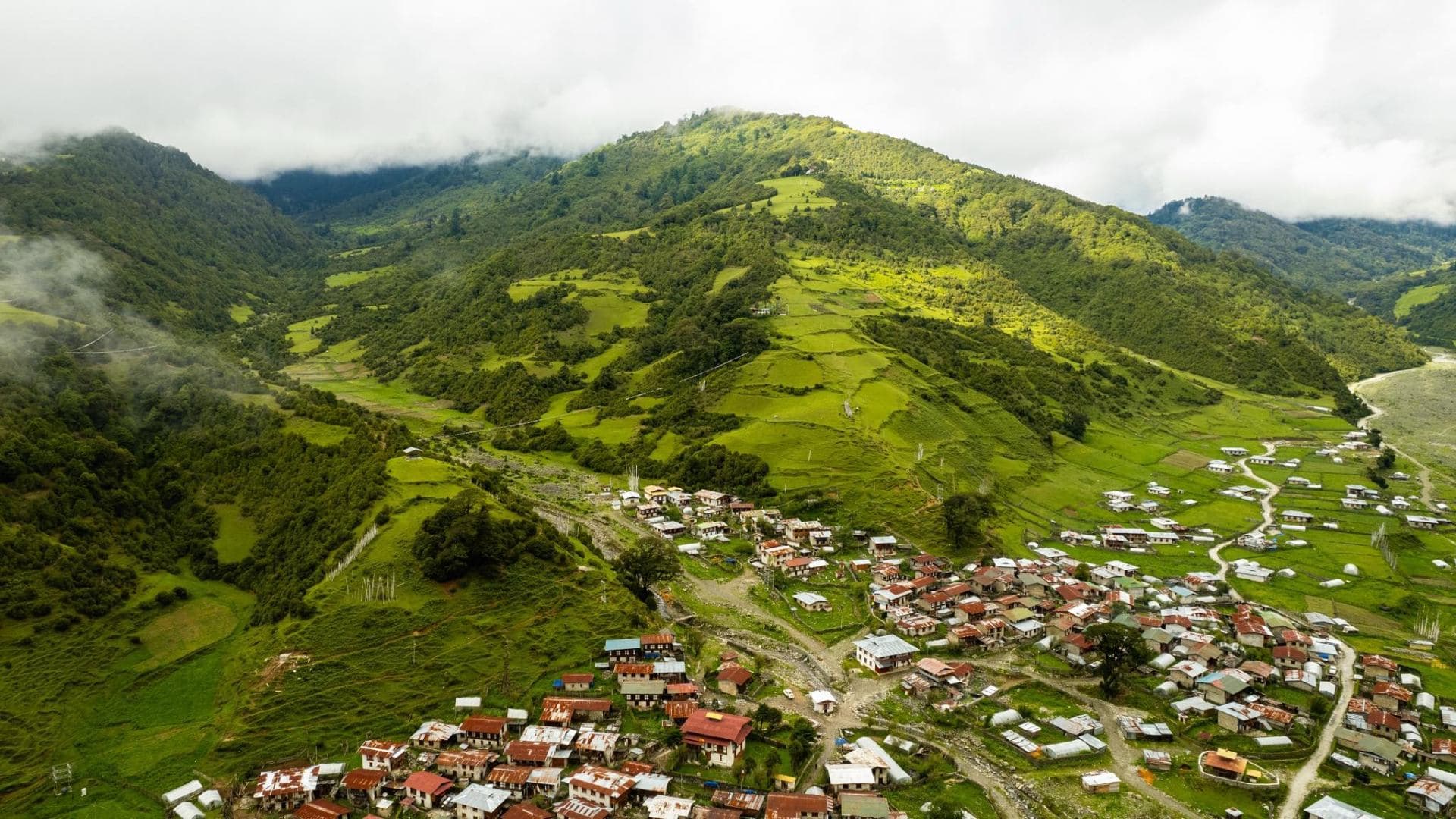
Bhutan never developed that performance. The monastery you visit in the Chhume valley was not built for visitors, has never been adapted for visitors, and does not operate on visitor time. The monks there are not guides in robes. They are monks. The dzong system, which combines administrative governance with religious function in a way that has no parallel anywhere else in Asia, was not preserved as heritage. It was simply never discontinued.
The traveller who understands this arrives differently. They are not a guest at a cultural exhibition. They are a witness to something that is still, quietly and with complete indifference to their presence, going on.
The Dzong as Living Institution
To understand what Bhutan's sovereignty has produced architecturally and institutionally, look at the dzongs. These fortress-monasteries, built at the confluences of rivers and at the heads of valleys, have served continuously as centres of both religious life and civil administration since the seventeenth century. They were not designed by any outside architectural tradition, carry no colonial influence in their construction, and were never repurposed or rebuilt to suit a changing political order.
Punakha Dzong, which sits at the meeting of the Pho Chhu and Mo Chhu rivers, was constructed in 1637. The monks who descend from Thimphu each winter to take up residence there are following a pattern of movement that has continued for nearly four centuries without significant interruption. The structure itself has been restored after flood and fire, as any living building must be, but its function, its occupants, and its place in the life of the valley are unchanged.
This is not preservation in the museum sense. It is continuity. The distinction matters to the traveller who is paying attention.
Bhutan never developed a performed version of itself, a face turned toward the visitor. It is, quite simply, what it has always been.
Fourteen Centuries and the Sense of Unbroken Time
Bhutan's sovereignty stretches back to the early seventh century, when Guru Rinpoche, known to Bhutanese as Padmasambhava, is said to have flown on the back of a tigress to the cliffside at Paro and meditated in a cave that would become, centuries later, the site of Paro Taktsang. The kingdom that formed around Himalayan Buddhist traditions was never unified by conquest from outside. It consolidated itself from within, through the authority of religious figures and, from the seventeenth century onward, through the institutional architecture of the Zhabdrung, the monk-ruler who gave the country its administrative coherence.
None of this was interrupted by a colonial power. No foreign legal system replaced the indigenous one. No foreign language became the language of administration or aspiration. Dzongkha, the national language, was not a compromise or a colonial inheritance. It is simply what Bhutanese speak.
The traveller who carries this history with them, even lightly, begins to notice things they would otherwise miss. The confidence of a farmer greeting a stranger on a mountain path. The unhurried authority of a monk who has no interest in being photographed. The absence, which becomes palpable after a few days, of any attempt to make the country legible to an outside gaze.
What the Traveller Carries Home
There is a quality that visitors to Bhutan sometimes struggle to name when they return. They say the country was peaceful, but that is not quite it. They say it was beautiful, which is true but insufficient. What they are reaching for, in most cases, is the feeling of having been somewhere that was entirely itself — somewhere that refused to become ordinary on their behalf.
That refusal is not accidental. It is the product of fourteen centuries of a culture that was never colonised, never absorbed, never forced to negotiate its identity with an outside power. The fact that Bhutan was never colonised is not a matter of pride or tourism branding. It is the explanation for everything the traveller feels but cannot quite place.
To travel Bhutan with genuine curiosity is to encounter a civilisation that did not wait for permission to remain whole. That is rarer than any landscape or festival or luxury property. It is, in the end, what the journey is for.
We keep our numbers small because Bhutan asked us to.
Ogyen & Co designs bespoke private journeys through Bhutan for very few guests each year. Correspondence by arrangement only.
Begin a correspondence