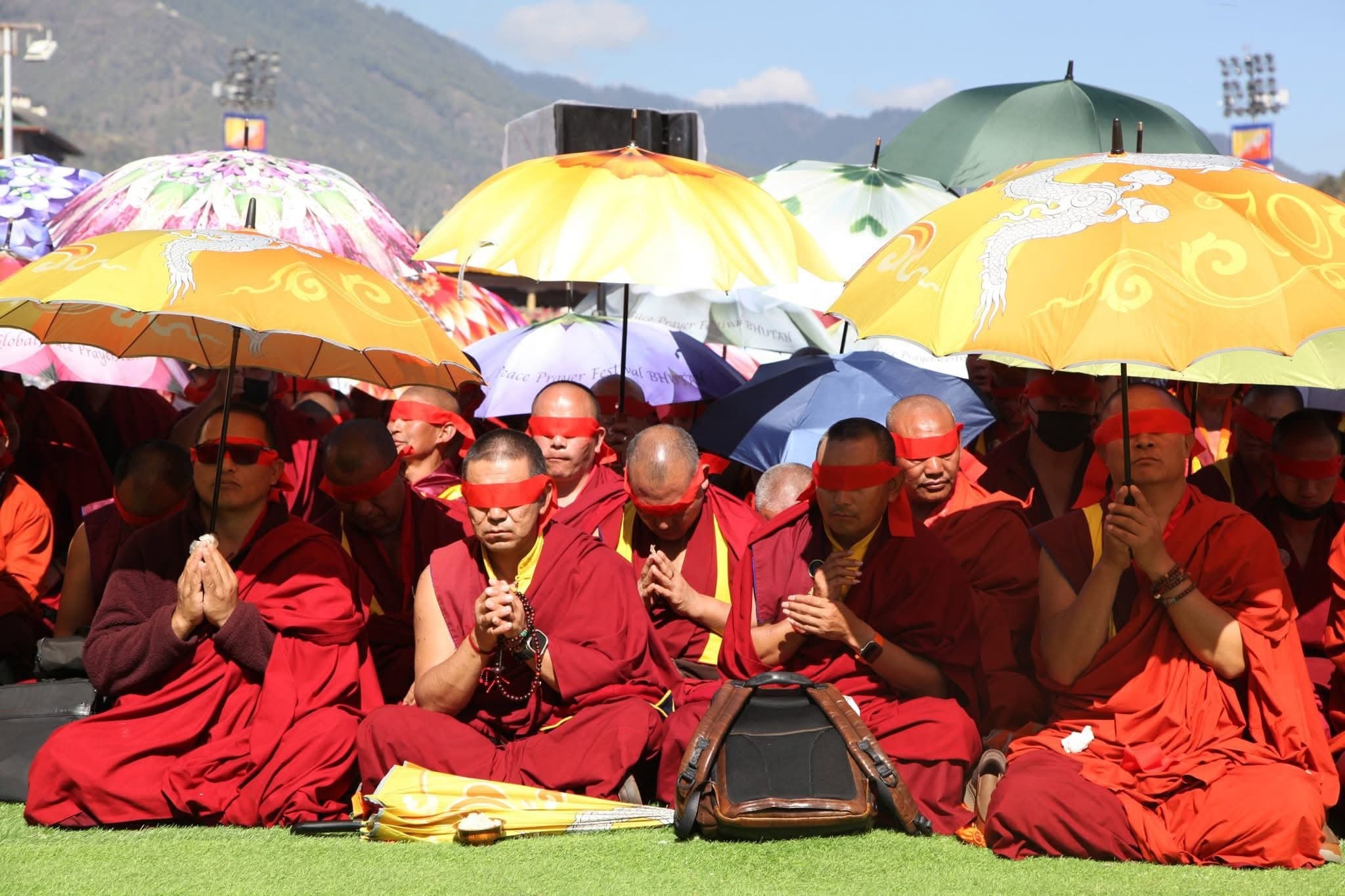
There is a difference between a place that was once sacred and a place that is sacred still. The first category is large and well documented. The great cathedrals of Europe, the temple complexes of Angkor, the oracle sites of ancient Greece: these are places where the sacred was, where it accumulated over centuries and left an impression that the attentive visitor can still feel, the way you can feel the shape of a piece of furniture that has been moved from a room. The impression is real. The thing itself is gone.
Bhutan belongs to the second category, and this is not a romantic claim. It is a structural one. The kingdom has maintained uninterrupted sovereignty for over fourteen centuries, and in that time the framework within which the sacred is understood, the relationship between the landscape and the divine, between the monastery and the valley it inhabits, between the living monk and the teaching he carries, has not been interrupted, exported, museumified, or repackaged for outside consumption. The bhutan spiritual travel experience is not a reconstruction of something that used to exist. It is a continuation of something that never stopped.
That distinction changes everything about what it means to arrive.
The Landscape as Scripture
In Bhutan, the sacred and the geographical are not separate categories. This is not metaphor. The doctrine of beyul, the hidden valleys that Guru Rinpoche is said to have consecrated in the eighth century as places of refuge and spiritual power, means that the landscape itself carries religious significance that predates and underlies everything built within it. The valley is not the backdrop for the monastery. The monastery is the response to the valley.
Paro Taktsang, which clings to a cliff face above the valley floor at an altitude that requires the body's full attention on the way up, is the most visible example of this principle, but it is not the only one. The Bumthang valley, which Bhutanese regard as the spiritual heartland of the kingdom, has a quality of atmosphere that visitors consistently struggle to describe and consistently notice. The air is different. The light falls differently. Something in the proportion of the valley to the sky creates a sense of enclosure that feels less like geography and more like intention.
The traveller who understands the beyul tradition arrives in Bumthang with a different set of questions than the one who arrives with a checklist of temples. They are not asking what was built here. They are asking why here, and the answer to that question is far more interesting.
Faith as Daily Infrastructure
One of the things that bhutan luxury spiritual journey guests remark on, often with some surprise, is that faith in Bhutan is not confined to the monastery. It is present in the daily infrastructure of ordinary life in a way that has no parallel in most of the countries they have travelled through.
The prayer flags that line every mountain pass are not decorative. They are a technology of intention: each flag printed with mantras that the wind carries outward, blessing everything in their path. The chortens at valley crossings are not monuments to the dead in the Western sense. They are active structures, built to accumulate merit for the community and to mark the landscape as one in which the spiritual and the physical are understood to be continuous.
The farmer who turns a prayer wheel on the way to his field in the morning is not performing religiosity. He is doing what the day requires, in the same spirit and with the same matter-of-factness as the act of irrigation or planting that follows. Faith in Bhutan is not a compartment of life. It is the medium through which life is conducted.
The visitor who notices this, rather than photographing it, begins to understand something about the quality of presence that Bhutan produces. It is not manufactured calm. It is what a society looks like when it has organised itself, for fourteen centuries and without outside interference, around the proposition that the inner life is as real and as requiring of cultivation as the outer one.
What Sacred Architecture Actually Does
The dzongs of Bhutan are the most immediately impressive expression of the kingdom's sacred architecture, and they are worth understanding as more than buildings. The dzong form, which combines a fortress exterior with a monastery interior, was developed by Zhabdrung Ngawang Namgyal in the seventeenth century as a physical expression of the relationship between temporal and religious authority. The two are not separated. They are housed together, by design, in the same structure.
Walking into Punakha Dzong through its wooden entrance bridge, through the outer courtyard and into the inner one where the monks' quarters face the central utse tower, is an experience that organises the body before it organises the mind. The scale is calibrated to produce a specific effect: you are small, the institution is large, and the institution has been here, doing what it does, for nearly four centuries. This is not intimidation. It is orientation. The architecture is telling you where you are in relation to something that matters.
The traveller who arrives at a dzong as part of a group, moving at the group's pace and departing when the schedule requires, receives the architecture's surface. The traveller who arrives privately, with a guide who has a genuine relationship within the dzong and the time to stand still in the inner courtyard until something shifts, receives something closer to its intention.
Arriving as a Guest of the Sacred
The question that bhutan spiritual travel asks of the visitor is not whether they share the religious framework of the Bhutanese. It is whether they are willing to arrive with the quality of attention that sacred spaces require, regardless of their own tradition or the absence of one.
That quality of attention is not complicated to describe. It is slowness, genuine rather than performed. It is the willingness to be in a place without immediately converting the experience into a photograph or an opinion. It is the recognition that the monastery you are standing in has its own purpose, its own rhythm, and its own claim on the space, and that the visitor's role is witness rather than protagonist.
The bhutan luxury spiritual journey that honours those conditions is not a retreat programme or a curated wellness sequence. It is simply a private journey through a country that has kept its sacred life intact, guided by someone who knows how to move within it, and paced in a way that allows the country to reveal itself rather than perform itself.
Ogyen & Co designs bespoke private journeys through Bhutan for very few guests each year. For those who come with a genuine interest in the spiritual dimension of the kingdom, we build the itinerary around that interest from the beginning, not as an add-on to the standard route but as the organising principle of the journey itself. If that is the kind of travel you are considering, we welcome correspondence by arrangement only.
We try to design journeys that honour that distinction. We keep our numbers small because Bhutan asked us to.