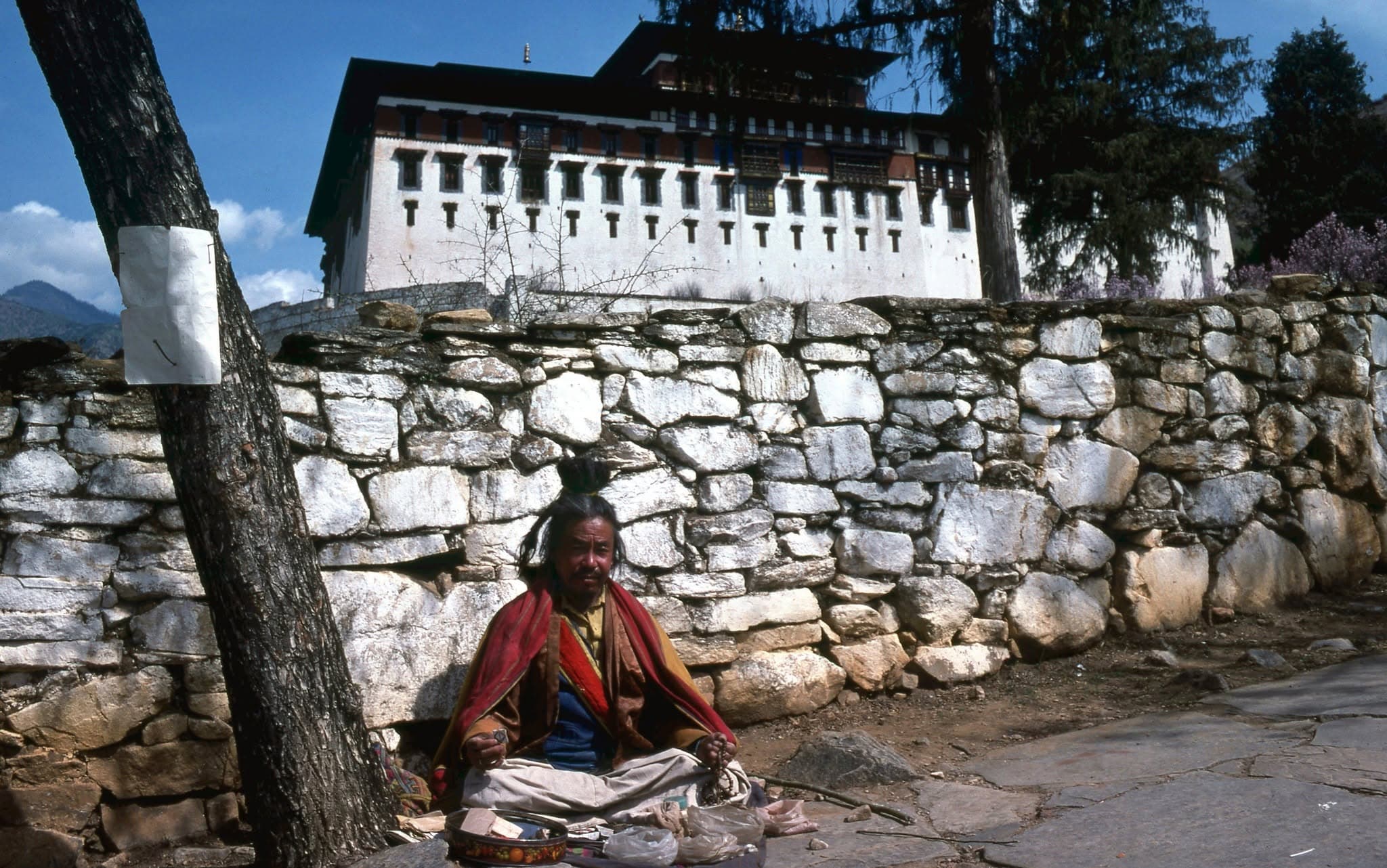
Somewhere on the road between Thimphu and Punakha you may pass someone performing full-body prostrations along the verge.
They stand, raise their hands above the head, touch the forehead, throat and heart, then go down full length on the ground with arms extended. They mark the point their fingers reached, stand at that mark, and do it again. They are covering the entire distance to a monastery this way, and it will take them weeks.
Western visitors reliably describe this as an extreme expression of faith, which is a sympathetic reading and a slightly wrong one. It treats the body as the medium through which an inner devotion is being expressed, as if the real event were happening somewhere else and the prostration were its outward sign.
In the tradition being practised, there is no somewhere else. The practice is not a demonstration of devotion. It is the devotion, and there is no separate interior version of it that could have been performed instead.
The Split Has a Date, and It Is Not a Bhutanese One
The reason this is difficult for most visitors to parse is that they are carrying an inheritance they did not choose and mostly cannot see.
European thought made a decisive move in the seventeenth century, formalised in Descartes and prepared long before him, that divided the human being into a thinking substance and an extended physical one. Mind here, body there, two categories requiring some account of how they interact. Every subsequent Western institution was built on top of that division. Medicine took the body. Religion took the soul. Psychology later arrived to handle whatever fell between them. Universities have separate faculties. Hospitals have separate departments. Insurance has separate schedules.
This is such a thoroughly assimilated structure that it registers as a description of reality rather than as one civilisation's particular theory.
Bhutan simply never had that event.
There is no moment in the intellectual history of this region where the person was cut in two and the halves assigned to different professions. The consequences run everywhere, and they explain most of what visitors find hard to categorise here. There is no Bhutanese word that maps cleanly onto spirituality as a domain distinct from ordinary physical life, because a domain like that requires a prior separation to be carved out of.
Why the Practices Are All Physical
Look at what religious practice actually consists of in this country and the pattern is unmistakable once noticed.
Prostration is physical, and the count matters because each one is performed. Circumambulation is walking, in a specific direction, for a specific number of rounds. Prayer wheels are turned by hand, or by water, or by wind, and the merit is understood to accrue through the turning. The pilgrimage routes are difficult on purpose, and the difficulty is not a filter on the sincere but part of the practice itself. The great masked dances at a tsechu are performed by monks whose training is choreographic and physical, and watching them is understood to be efficacious for the watcher, which is a claim about bodies in a courtyard rather than about states of mind.
The advanced practices are more explicit still. Tsa lung trul khor works directly with breath and channels and physical movement, and it is not a preliminary to the real contemplative work. It is the contemplative work, conducted in a body, because there was never a proposal that it might be conducted anywhere else.
Even the retreat traditions, which look from outside like withdrawal from the physical, are governed by minutely specified physical conditions: posture, diet, sleep, the orientation of the room, the hours. A lama giving instruction to a serious practitioner sounds remarkably like a physician giving instruction to a patient, and this is not a coincidence of tone. As the previous chapter noted, the medical lineage and the religious lineage in this tradition are the same lineage, transmitted by the same institutions, tracing to the same source.
Medicine here is a branch of dharma. Not adjacent to it. Inside it.
What This Means for the Category Being Sold
Which brings us to the phrase in the metadata of this essay, and to an entire market segment.
Spiritual wellness, as a category, exists to repair something. It is a response to a felt problem: that the physical treatments do not touch whatever is actually wrong, and that the contemplative practices feel disembodied and abstract. The category proposes to reunite them, and the standard delivery is a programme in which meditation sessions and spa treatments appear on the same schedule.
The trouble is that a schedule with both things on it is not integration. It is two categories in one building, which is precisely what the guest already had at home and precisely why it produces the specific flatness people report afterwards. A great deal happened. None of it connected. The programme could not connect it, because the framework that separated them in the first place was never examined, only accommodated.
Bhutan is not a better implementation of that category. It is a place where the problem the category exists to solve did not arise.
That is a difficult thing to sell, because it cannot be delivered as a component. There is no session in which the guest receives it. It is a property of the surrounding culture, and the only way to acquire any of it is to be inside that culture for long enough that its assumptions become briefly visible as assumptions, at which point one's own become visible too. That is what the good version of this journey actually does, and it takes days rather than hours.
The Whole Argument, In One Place
This series has been circling a single claim from several directions and it can now be set down complete.
Everything in Bhutan that works on a visitor runs on duration rather than intensity, and it does so because the tradition holds a unified view of what a person is.
The blessing accumulated in an ancient chapel requires enough time in the room to register. Acclimatisation ignores every input except elapsed hours at height. The medicinal springs are attended for a week because efficacy is a function of sustained conditions. Traditional medicine prescribes conduct before pharmacology and assesses across seasons. The walk to a cliff monastery cannot be shortened without destroying it. Meditation instruction from a Bhutanese teacher is almost never about technique and almost always about continuing.
Six different domains. One principle, applied identically, because they were never six domains here.
The Western wellness market cannot reproduce this by assembling the components, and the reason is now clear. The components were separated by an intellectual move made four centuries ago on another continent, and reassembling separated things produces an assembly rather than a whole. What Bhutan offers is not a superior programme. It is a functioning example of the alternative, still operating, in which a person's body and a person's practice were never two subjects.
You cannot buy that. You can go and stand in it for a while, and pay attention, and notice what happens to the assumption you brought.
That is the entire proposition of this country, honestly stated, and it explains why we build journeys the way we do.
Ogyen & Co designs bespoke private journeys through Bhutan for very few guests each year. We do not offer spiritual wellness programmes, because the country is not organised in a way that would make such a programme coherent, and what we build instead is time inside the thing itself. We welcome correspondence by arrangement only.
We try to design journeys that honour that distinction. We keep our numbers small because Bhutan asked us to.
About Ogyen & Co
Ogyen & Co is a licensed private tour operator based in Thimphu, designing bespoke journeys through the Himalayan Kingdom of Bhutan for a small number of guests each year. Single departures only, by arrangement.
ogyen.co · Private journeys · Travelogues · Enquire · hello@ogyen.co