A certain kind of honeymoon has been perfected elsewhere. It involves an overwater villa, a private plunge pool, rose petals on a turned-down bed, and a sunset that the resort has organised a table around. It is designed to be about the couple and nothing else, and it does that well.
Bhutan does not do this, and it should not be asked to.
There are no beaches here and no overwater anything. Nights in the high valleys are cold for much of the year. Public displays of affection are quietly out of register in a country where dress codes still apply in every dzong and temple. A couple who arrives expecting a romantic resort in the mountains will find the lodges beautiful and the country somewhat indifferent to the premise.
We raise this not to discourage anyone. We raise it because the couples who come for the right reason tend to describe the journey afterwards as the most significant thing they did together, and the couples who come for the wrong one tend to describe it as cold.
What the Kingdom Does Instead
What Bhutan offers two people is not a setting organised around them. It is a country that has its own long understanding of what a union is, and that will, if approached properly, include them in it.
Marriage here is a matter of auspicious timing before it is a matter of ceremony. Families consult astrologers on the date, and the reading of a couple's charts is taken seriously in a way that visitors often find unexpectedly moving. We can arrange a private astrology reading for the two guests, conducted as it would be for a Bhutanese couple rather than as a performance for a foreign one.
We can arrange, too, a private blessing from a lama, in a temple rather than at the lodge, with the time and the prayers chosen for the couple. It does not replace a wedding, and it is not meant to. It is an acknowledgement, in the kingdom's own terms, that two people have made a decision.
Chimi Lhakhang, Properly
Most itineraries include the temple of Chimi Lhakhang in the Punakha valley, and most present it as a curiosity. It is associated with Drukpa Kunley, the fifteenth-century saint remembered as the Divine Madman, and the village on the way is painted with the symbols of his irreverent teaching. The guidebooks make a joke of it.
It is not a joke to the people who go there. Chimi Lhakhang is a fertility temple in active use, where Bhutanese couples come to pray for children and families bring newborns to receive their names. For a couple at the beginning of a marriage, standing in that courtyard while another family's child is named is not a curiosity. We would include it in a honeymoon only if the couple wanted to go for what it is, and we would ask them first.
The Days, Designed for Two
The practical design of a honeymoon in Bhutan differs from other journeys in a few specific ways.
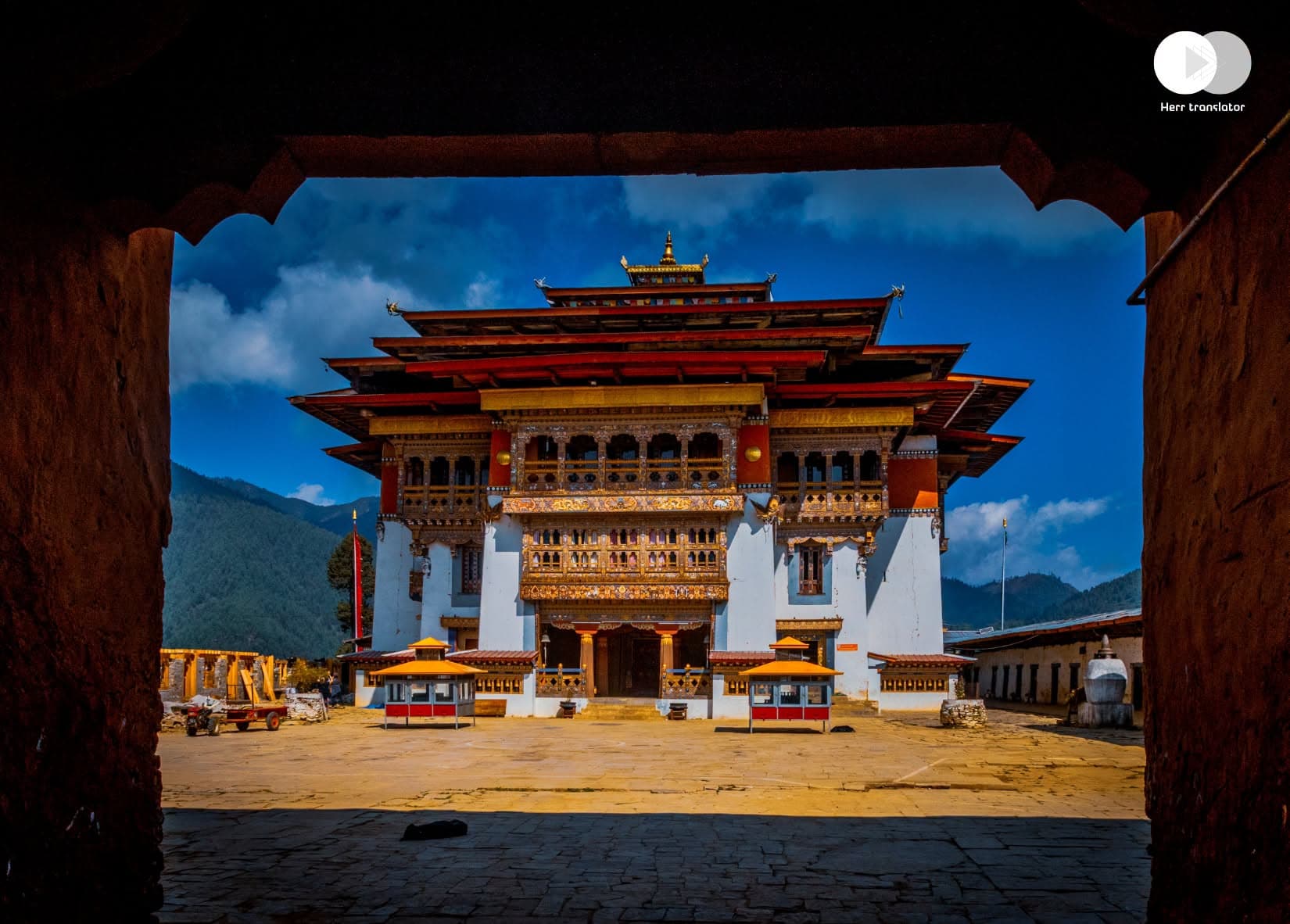
We give the couple more unscheduled time, not less. We choose suites with stoves and views rather than proximity to town. We lay a private picnic on a pass or beside a river, with food prepared by a five-star hotel, so that lunch on a long drive becomes one of the days rather than an interruption to it. We arrange breakfast at Gangtey Goenpa during the monks' morning prayers, which is about as far from room service as a morning can be, and which couples almost always name afterwards. In place of a crowded festival courtyard, we can bring the masked dances to the lodge, performed by monks as they would be at a tshechu, for the two guests alone.
And we encourage at least one evening of the traditional hot stone bath, the dotsho, in which river stones are heated in a fire and dropped into a wooden tub of water infused with herbs. It is the closest the kingdom comes to a spa ritual of its own, and it is best taken slowly, by two people with nowhere else to be.
When to Come
For a honeymoon, the seasons sort themselves plainly. Autumn gives the clearest skies. Winter gives the most solitude, the warmest days in Punakha and the cranes in Phobjikha. Spring gives the rhododendrons on the passes. The monsoon we would avoid for a first journey together, though a couple returning for an anniversary might find it the most intimate season of all.
What It Leaves
The romantic resort is designed to produce a week of perfect days, and it often succeeds. What it cannot produce is a shared encounter with something larger than the couple, and that is what Bhutan is unusually good at providing.
Couples who come here for that tend to leave with something harder to photograph than a sunset: an astrologer's reading of their future, a blessing in a language neither of them speaks, a morning in a monastery where no one was performing anything for them. It is not romance, exactly. It lasts longer.
Ogyen & Co designs bespoke private journeys through Bhutan for very few guests each year, including a small number for couples at the beginning of a marriage. We design those journeys around what the kingdom can give two people, rather than what a resort would. We welcome correspondence by arrangement only.
We try to design journeys that honour that distinction. We keep our numbers small because Bhutan asked us to.
About Ogyen & Co
Ogyen & Co is a licensed private tour operator based in Thimphu, designing bespoke journeys through the Himalayan Kingdom of Bhutan for a small number of guests each year. Single departures only, by arrangement.
ogyen.co · Private journeys · Travelogues · Enquire · hello@ogyen.co