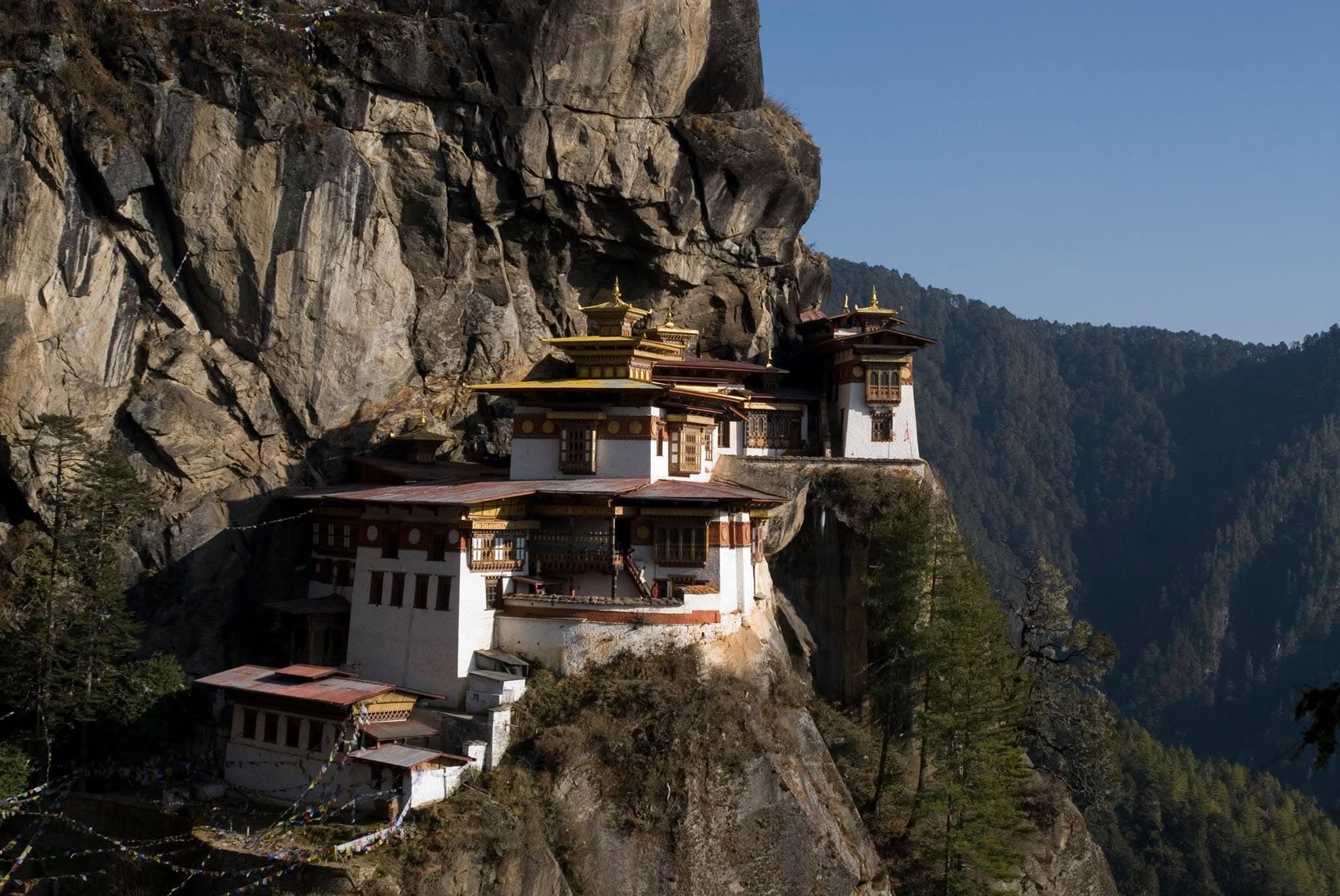
There is a moment on the walk up to Taktsang, roughly two thirds of the way, when the path finally brings the monastery into full view across the gorge and you understand that you are going to have to lose most of the height you have just gained.
Six hundred or so steps drop into the ravine, past the waterfall, and then rise again on the far side to the entrance. The building is directly in front of you and it is entirely unreachable except by going down first. Everyone stops at this point. It is the only part of the walk that nobody photographs, and it is the part that actually explains the place.
Luxury Removes Friction. It Cannot Remove Effort.
Every other luxury product in travel operates by taking difficulty away. The transfer means you do not queue. The private guide means you do not wait. The suite means you do not compromise. Difficulty is the enemy and its removal is the entire proposition.
Applied to a mountain, that logic destroys the thing it is trying to improve. There is no version of Taktsang in which the guest arrives without having walked, and if there were, it would not be worth arriving at. The Bhutanese would not build a road to it, and the reason is not conservation.
So the useful distinction, and the one that governs how we build these days, is between friction and effort.
Friction is everything incidental. Starting at the wrong hour and walking in heat. Arriving alongside four coaches. Carrying the wrong layers because nobody explained the temperature at the top. Being hurried past the chapels because the group has a lunch booking. Descending on legs that were never prepared for descent, which is what actually injures people. Eating badly at the halfway point. Having no way to rest for twenty minutes without the day collapsing.
Effort is the walk itself. Nine hundred metres of gain, four to five hours on the feet, thin air at three thousand and more.
What a serious tigers nest private tour does is remove the first category entirely and leave the second completely intact. The guest starts before six with a packed breakfast, walks in cool air and near solitude, moves at whatever pace the body actually wants, stops when there is a reason to stop, and reaches the upper chapels ahead of the volume. Everything unpleasant has been engineered out. Everything difficult remains, deliberately, because the difficulty is the content.
What the Bhutanese Are Doing on the Same Path
Walk up on a Bhutanese auspicious day and you will be overtaken repeatedly, which is instructive if slightly humbling.
The people passing you are frequently in their sixties and seventies, dressed in kira and gho, carrying nothing technical, wearing shoes that no outfitter would approve. They are not treating this as a hike. They are not measuring it, and they will not describe having completed it afterwards. Many of them have done it dozens of times and will do it again next year.
This is neykor, and the word is worth sitting with because it is usually translated as pilgrimage and that translation carries the wrong associations. Its sense is closer to circling a sacred place. Not travelling to a destination and arriving, but moving around and toward something in a way where the moving is itself the practice.
The distinction has practical consequences on the path. A hiker's attention runs forward to the summit and treats everything before it as expenditure. A pilgrim's attention is on the current step. The hiker experiences the descent into the gorge as a cruel design flaw. The pilgrim experiences it as more of the same thing they were already doing.
Guests who understand this before they set out have a materially different morning from those who do not, and the explanation takes about ninety seconds in the car.
The Cave, the Tigress and the Fire
The legend is well known and usually flattened in the telling.
Guru Rinpoche came to this cliff in the eighth century carried on the back of a tigress, and in one telling the tigress was his consort Yeshe Tsogyal, who took that form for the journey. He meditated in the cave at Pelphug in a wrathful aspect, subduing the local spirits that were obstructing the establishment of the dharma in this valley. The monastery was built around the cave in 1692, some nine centuries after the event it commemorates.
Two things about this are worth holding.
The first is that the cave came before the building, which is the correct order and the reverse of how visitors usually perceive it. Nobody chose a dramatic cliff and constructed something impressive on it. Someone meditated in a cave, and the significance accumulated, and eventually a structure was raised to house what was already there. The architecture is a consequence.
The second is the fire. In 1998 the main structure burned, and much of what stands today was rebuilt in the years after, completed in 2005. Visitors sometimes find this disappointing, as if the authenticity were compromised. The Bhutanese response to that reaction is essentially incomprehension. The cave did not burn. The site was never the timber.
The Rest of the Mountain
Taktsang is the walk everyone knows, and it is a morning, not a trek. The country behind it is a different proposition entirely and almost nobody sees it.
The Druk Path runs five or six days between Paro and Thimphu, crossing high country past a chain of lakes at around four thousand metres, and it is the most accessible serious route in the kingdom. At the other extreme, the Snowman Trek runs close to a month along the northern frontier, crossing a succession of passes above four and a half thousand metres, and it is widely regarded as among the hardest treks on earth. It is frequently closed by snow. A substantial proportion of people who begin it do not finish.
Bhutan luxury trekking, as the phrase is generally used, means the removal of camp discomfort: better tents, better food, staff, a hot bath at the end of the day. That is worth having and we arrange it. But it is again a friction solution, and applied to a route like the Snowman it is close to beside the point. Nothing available for money makes a fortnight above four thousand metres comfortable.
What it can do is make the difference between a route that is survivable and one that is legible. A guide who knows which valley holds which shrine, which pass has which protector, and why the herders move when they move, converts a long walk in beautiful country into something with a structure. Without that, high-altitude Bhutan is scenery with weather.
Why the Difficulty Is Not Incidental
Here is the argument that the marketing around sacred sites consistently avoids, because it does not sell comfortably.
In this tradition the body is not a vehicle carrying a mind to a temple. It is the instrument of the practice. Prostration is physical. Circumambulation is physical. The hundred and eight bows are counted because they are performed. The reason the significant sites in Bhutan are almost all difficult to reach is not a historical accident of where caves happen to be. Remoteness was selected for, because arriving somewhere without cost produces a different internal state from arriving having spent something.
This is why the walk cannot be optimised away without destroying the destination, and it is why the guest who is carried up on a horse to the halfway point, which is possible and which we will arrange for anyone who needs it, consistently reports a thinner experience than the one who walked.
It also cuts against a certain kind of luxury instinct that we encounter regularly and push back on, gently. The question is usually some version of whether there is a way to do this that is easier. There is, and it is available, and it produces a photograph rather than a morning.
The thing that people describe years afterwards is almost never the view from the top. It is the descent into the gorge, when the building was directly opposite and they had to go down before they could go up, and the only available response was to keep walking.
Ogyen & Co designs bespoke private journeys through Bhutan for very few guests each year. We build the Taktsang morning around an early start, an unhurried pace and access to the inner chapels ahead of the volume, and we prepare guests honestly for what the walk asks of them rather than describing it as moderate. We welcome correspondence by arrangement only.
We try to design journeys that honour that distinction. We keep our numbers small because Bhutan asked us to.
About Ogyen & Co
Ogyen & Co is a licensed private tour operator based in Thimphu, designing bespoke journeys through the Himalayan Kingdom of Bhutan for a small number of guests each year. Single departures only, by arrangement.
ogyen.co · Private journeys · Travelogues · Enquire · hello@ogyen.co