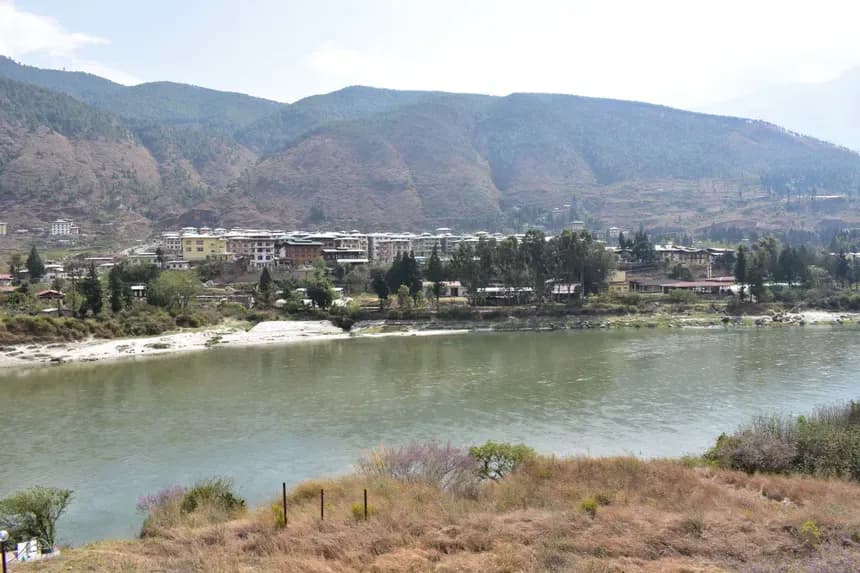
Most visitors to Bhutan learn about its Bitcoin after they arrive, usually from a guide who mentions it in passing on the road to Punakha, somewhere between the dzong and the rice terraces. The reaction is almost always the same. It seems out of place in a country that limits tourism, protects its forests by constitution and measures its progress in happiness.
We think it is less out of place than it seems, and the reason is water.
What the Rivers Do
Bhutan's economy has long rested on hydropower. Its rivers fall steeply from the Himalaya to the plains, and the kingdom has built a network of plants that sell much of their output to India. The difficulty is seasonal. In the monsoon the rivers carry far more water than domestic demand can use, and energy that cannot be sold or stored is energy lost.
Druk Holding and Investments, the state's investment arm, began using some of that surplus to mine Bitcoin. Public reporting dates the kingdom's Bitcoin activity to at least 2019, and on-chain analysts have at times estimated its holdings at more than a billion dollars, which has placed Bhutan among the largest known nation-state holders.
The figures change with the market and with the kingdom's own decisions, and we would not quote them as current. The principle is stable. Bhutan did not buy its Bitcoin. It converted water that would otherwise have run past the turbines into an asset it could keep.
Why It Fits
The usual objection is environmental, and it deserves a straight answer. Bitcoin mining consumes a great deal of energy, and most of the criticism of it is about where that energy comes from. In Bhutan it comes from rivers, and specifically from surplus that had no other buyer. That does not settle every argument, but it removes the one most often made.
The deeper fit is temperamental. Bhutan is a country that thinks in long horizons. It was never colonised, it opened to tourism carefully and late, and it charges visitors a fee each night so that the country is not consumed by them. Holding a reserve asset mined from its own rivers, and holding it quietly, is consistent with that. The kingdom has never been loud about its Bitcoin. It is more often discovered than announced.
Gelephu
In January 2025, Gelephu Mindfulness City, the special administrative region being built on Bhutan's southern border, announced plans to hold Bitcoin, Ether and BNB among its strategic reserves. In December of the same year the government made a further pledge of up to 10,000 BTC toward the city's development.
Gelephu is the clearest expression of the kingdom's digital-asset position. It has its own legal framework, designed in part for companies offering digital-asset financial services, and it is intended to become a hub connecting South and Southeast Asia over the coming decades. It is also very early. Much of what is planned there is still plans, and a traveller who arrives expecting a finished city will find a construction site and a set of intentions.
For some guests, that is exactly the point. To stand in the place where a country is deciding what kind of economy it wants to have is unusual, and Gelephu, reached by road from the south or by domestic flight, can be the last stage of a longer journey through the kingdom.
What a Visitor Can and Cannot See
Here is the limit. The mining operations are not open to visitors, and we do not offer tours of them. There is no Bitcoin museum, no conference circuit and no district of the capital given over to the industry. A traveller who comes to Bhutan to see crypto will see very little of it.
What they can see is the reason it exists: the rivers in flood, the dams in the gorges, the forests that cover most of the country and that the constitution requires it to keep. They can see a culture that treats restraint as a virtue rather than a constraint, and a state that has made a large, long-term bet without much announcement. For a guest who works in digital assets, that is a more useful thing to have seen than a server hall.
Ogyen & Co designs bespoke private journeys through Bhutan for very few guests each year, including journeys that end in Gelephu for guests whose interest in the kingdom extends to its economic future. We accept payment in crypto through Binance Pay via DK Bank. Figures on national holdings change and are cited here as reported, not as current. We welcome correspondence by arrangement only.
We try to design journeys that honour that distinction. We keep our numbers small because Bhutan asked us to.
About Ogyen & Co
Ogyen & Co is a licensed private tour operator based in Thimphu, designing bespoke journeys through the Himalayan Kingdom of Bhutan for a small number of guests each year. Single departures only, by arrangement.
ogyen.co · Private journeys · Travelogues · Enquire · hello@ogyen.co