We should start by dismantling the thing this essay is supposed to be selling.
Bhutan is not disconnected. The mobile network reaches almost everywhere anyone goes. The hotels have good wifi and the lodges have better. Young Bhutanese are on the same platforms as young people everywhere, in comparable volume, with comparable enthusiasm. The government is building a mindfulness city at Gelephu, holds sovereign digital assets, and has been running national digital identity infrastructure that a number of far larger countries do not have.
The idea that one comes here to escape technology is a foreigner's fantasy about a small Buddhist kingdom, and it is inaccurate in a way that Bhutanese people find mildly irritating when they encounter it.
So the honest question is not what a country without connectivity feels like, because that country does not exist here. It is why attention behaves differently in a place where the infrastructure is essentially the same as home.
The Notification Is Not the Problem
Consider what actually happens when a message arrives.
The device makes a sound. That part is technological and it can be switched off, which everyone knows and which is why digital detox as a concept keeps failing. The reason it fails is that the sound was never the mechanism.
The mechanism is the expectation of a reply, and the expectation is social rather than technical. It exists because everyone in your professional and personal environment shares an unspoken agreement about acceptable response times, and violating that agreement carries a cost. The phone is merely the delivery system for an obligation that other people are imposing and that you are participating in imposing on them.
A retreat that confiscates devices addresses the delivery system and leaves the obligation completely intact. The guest hands over the phone and spends the afternoon thinking about what is accumulating on it. This is worse than not surrendering it, and anyone who has tried it knows the feeling.
What is different in Bhutan is not the signal. It is that you have entered a set of circumstances where the obligation is legibly suspended for everyone involved. You are nine hours ahead or eleven or thirteen. You are in the mountains. The people who would otherwise expect a same-day reply understand that you are somewhere that does not work that way, and crucially, they understood it before you left. The permission was granted at the point of booking rather than at the point of arrival.
That is the actual product, and no compound or lockbox can manufacture it, because it is not about you. It is about what other people expect of you, which changes only when the destination is genuinely far away and generally understood to be so.
What Silence Actually Sounds Like Here
The word silence in the title of this piece is imprecise and should be corrected, because guests who arrive expecting quiet frequently have a difficult first night.
Bhutan is not quiet. It has a different noise floor, which is a separate thing.
The dogs are the immediate case and the one nobody mentions in the brochures. Thimphu has a substantial free-roaming dog population, they are largely nocturnal in their social arrangements, and they bark in relays across the valley for much of the night. Guests who were promised a silent kingdom encounter this on night one and conclude that something has gone wrong. Nothing has gone wrong. It is simply the case, and being told about it in advance converts it from an outrage into a feature within about two nights.
What is genuinely absent is mechanical sound. There is very little traffic at night outside the capital, no aircraft overhead because the flight paths are minimal, no industrial hum, no distant motorway that you had stopped noticing years ago. What fills that space instead is specific and identifiable: the river, which in Punakha is loud and constant and becomes the sound you sleep to; wind moving through prayer flags, which has a particular papery rhythm that guests remember; hail on tin roofing, which is startling the first time; the low continuous recitation from a monastery before dawn if you are staying anywhere near one.
The valuable quality is not absence. It is that every sound present is one you can identify and none of them is asking anything of you. Modern acoustic environments are mostly composed of noise that carries information, and the mind processes it whether or not you attend to it. Bhutan's noise floor carries no messages.
The Dark
The part of this that guests are least prepared for and that affects them most is not acoustic at all.
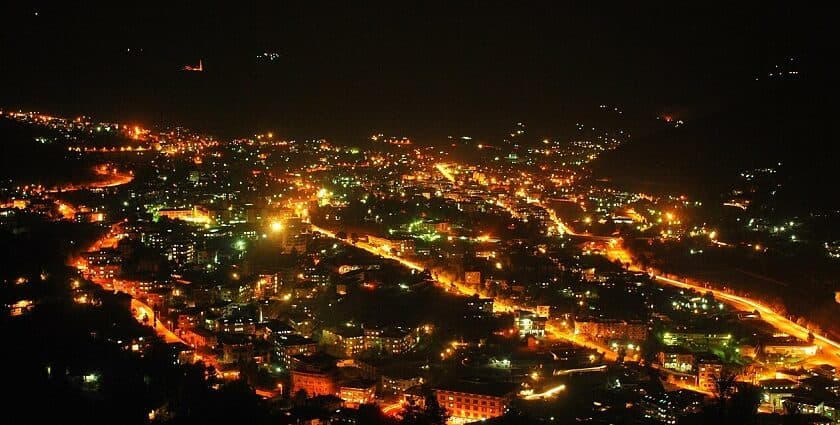
Outside Thimphu and Paro, Bhutan is dark at night in a way that most people from developed urban environments have simply never experienced. Not dim. Dark. There is no ambient glow on the horizon, no light pollution dome, no distant sodium wash. Step outside a lodge in Phobjikha or Bumthang after nine and the darkness is total and slightly disorientating, and the sky above it is dense with stars in a way that is genuinely difficult to describe to someone who has not seen it.
The physiological consequences are real and underrated. Darkness of that quality does things to sleep onset that no supplement replicates. A great many guests report the best sleep of their year in Bumthang and attribute it to the bed.
There is also something less measurable, which is that the darkness reintroduces a scale that urban life removes. It is very difficult to maintain an inflated sense of the urgency of one's own affairs while standing outside at three thousand metres under that particular sky. This is a cliché, and it is also, in our experience, reliably true.
Why We Would Not Sell This as a Detox
The framing matters and we decline it deliberately.
Detox implies that the guest arrives contaminated and leaves purified, and that the mechanism is abstinence. It positions the traveller as someone with a problem and the destination as a treatment. It also, quietly, promises something that does not survive the return flight. Anyone who has done a device-free week knows that the old pattern reasserts itself within about seventy-two hours of landing, and the failure is usually experienced as a personal one rather than a design flaw in the concept.
What we would say instead is narrower.
Bhutan gives you a socially legitimate reason to be unreachable, a physical environment that is not competing for your attention, and enough consecutive days that your attention span begins to lengthen rather than merely resting. That third element is the one that requires actual duration and that a long weekend cannot supply. Attention recovers slowly, and it recovers by being asked to hold things for longer, not by being deprived of stimulus.
The guest who reads three books in nine days here has done something structurally different from the guest who put their phone in a drawer. One has abstained. The other has practised.
Bhutan cannot fix your relationship with your devices, and any operator promising that is selling a story. What it can do is remove the ambient pressure for long enough that you notice what the pressure was doing, which is a smaller claim and the only one that holds.
Ogyen & Co designs bespoke private journeys through Bhutan for very few guests each year. We do not remove connectivity from our itineraries, and we tell guests honestly about the dogs. We welcome correspondence by arrangement only.
We try to design journeys that honour that distinction. We keep our numbers small because Bhutan asked us to.
About Ogyen & Co
Ogyen & Co is a licensed private tour operator based in Thimphu, designing bespoke journeys through the Himalayan Kingdom of Bhutan for a small number of guests each year. Single departures only, by arrangement.
ogyen.co · Private journeys · Travelogues · Enquire · hello@ogyen.co